
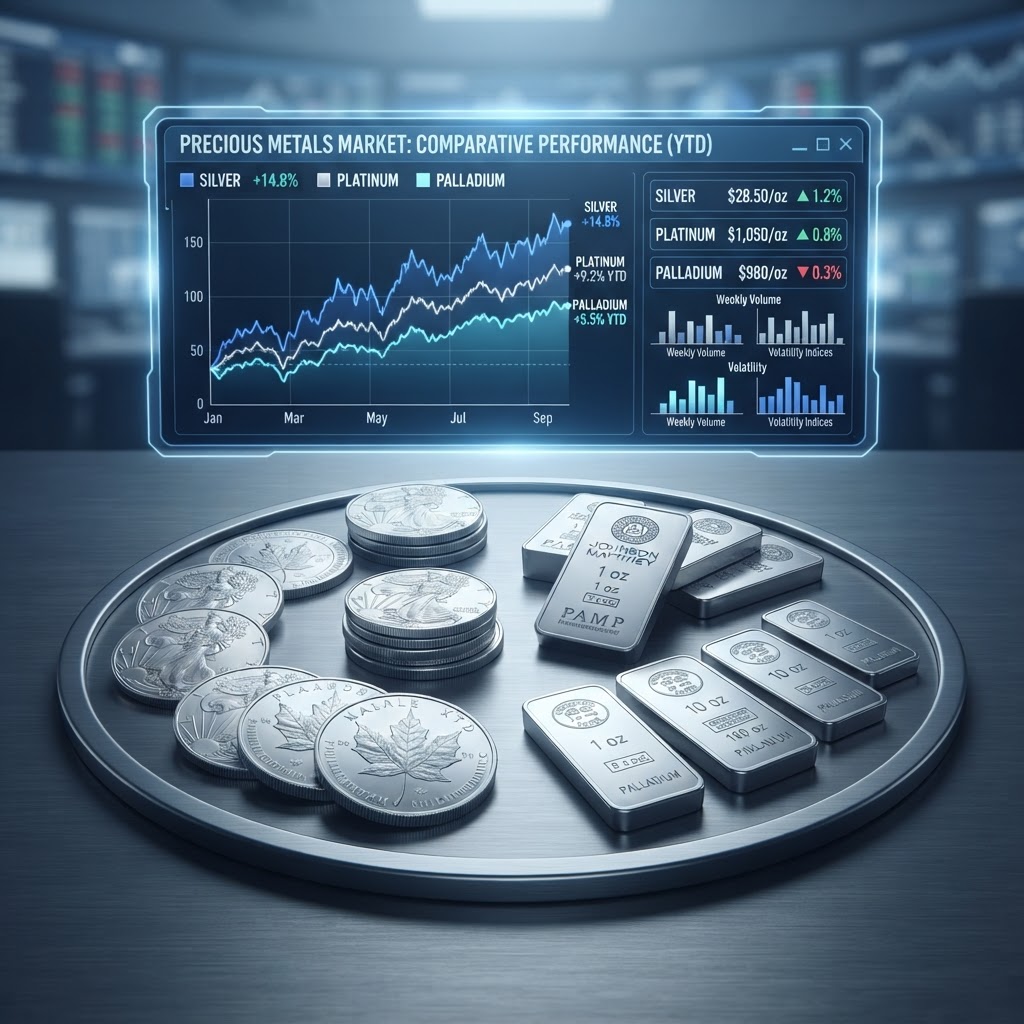
When investors think about precious metals, gold dominates the conversation. But the precious metals complex includes three other significant metals — silver, platinum, and palladium — each with its own supply-demand dynamics, its own price drivers, and its own role in a diversified portfolio. These metals are not simply lesser versions of gold. They are industrial commodities with monetary properties, and their price movements are driven by a combination of investment demand and real-world industrial consumption that makes them behave very differently from gold. Understanding the broader precious metals complex is essential for investors who want to read commodity markets accurately and who may want exposure beyond gold alone.
Silver: The Hybrid Metal
Silver is the most well-known of the non-gold precious metals, and it has a split personality that makes it fascinating to analyze. Roughly half of silver demand comes from industrial uses — solar panels, electronics, electrical contacts, medical applications, and brazing alloys. The other half comes from investment and jewelry demand. This hybrid character means silver is influenced by both industrial economic cycles and investment sentiment, and its price action can be more volatile than gold as a result.
The most important industrial demand driver for silver in recent years has been the solar energy industry. Photovoltaic panels use silver paste in their manufacture, and the rapid global buildout of solar capacity has created a structural source of demand that did not exist a decade ago. This has tightened the silver market and contributed to price strength even during periods when gold was stable. For investors reading the silver market, solar industry demand growth is the most important fundamental to track, because it is the incremental demand source that can drive prices independently of investment sentiment.
Silver’s price behavior has historically been more volatile than gold. During precious metals bull markets, silver tends to outperform gold by a significant margin. During bear markets, silver tends to underperform. This volatility makes silver attractive for investors who want leveraged exposure to the precious metals complex, but it also makes silver a more dangerous holding during downturns. The silver-to-gold ratio, which measures how many ounces of silver it takes to buy one ounce of gold, is a useful tool for assessing relative value. When the ratio is historically high, silver is cheap relative to gold and may outperform. When the ratio is historically low, silver is expensive relative to gold and may underperform.
Platinum: The Automotive Catalyst
Platinum is a dense, rare metal whose primary demand driver is the automotive industry. Platinum is used in catalytic converters, which reduce harmful emissions from gasoline and diesel engines. Roughly 40% of platinum demand comes from automotive use, with the remainder split between jewelry, industrial applications, and investment. This makes platinum’s price highly sensitive to automotive production cycles, emission regulations, and technological shifts in the automotive sector.
The most important long-term question for platinum is the trajectory of the automotive industry. The shift toward electric vehicles, which do not use catalytic converters, is a structural headwind for platinum demand, because electric vehicles do not consume platinum in the way that internal combustion engines do. However, the transition is slow, and hundreds of millions of internal combustion vehicles will remain on the road for decades. Platinum also has industrial uses in hydrogen fuel cells, which could provide a new demand source if hydrogen technology develops. For investors reading the platinum market, the automotive technology transition is the key long-term variable.
Platinum supply is concentrated in South Africa, which produces roughly 70% of the world’s platinum. This geographic concentration makes platinum supply vulnerable to disruptions — labor strikes, power outages, operational issues, and geopolitical developments in South Africa can all cause significant price moves. A supply disruption in South African mines can cause platinum to spike sharply even if demand is stable, because the market is tight and inventories are low. For investors reading platinum, supply-side developments in South Africa are as important as demand-side trends.
Palladium: The Gasoline Catalyst
Palladium is closely related to platinum and is used in catalytic converters, but primarily for gasoline engines rather than diesel. This distinction matters, because gasoline engines dominate the global automotive market, and palladium demand has historically been stronger than platinum demand as a result. Palladium’s price has at times exceeded platinum’s, despite platinum being traditionally considered the more precious metal, simply because of the strength of gasoline-powered automotive demand.
Palladium supply is concentrated in Russia and South Africa, which together produce the majority of the world’s supply. This concentration makes palladium particularly vulnerable to geopolitical disruptions. Sanctions, export restrictions, or operational issues in either country can cause sharp price moves. The palladium market is small and illiquid relative to gold or even platinum, which means that supply disruptions can cause exaggerated price reactions. For investors reading the palladium market, geopolitical developments in Russia are the single most important variable, because of the country’s dominant position in supply.
Like platinum, palladium faces a long-term headwind from the electric vehicle transition, since electric vehicles do not use palladium. However, the transition will take decades, and in the interim, palladium demand is supported by the continued production of gasoline vehicles and increasingly stringent emission standards that require more catalyst metal per vehicle. The balance between these forces determines palladium’s long-term trajectory.
Reading the Precious Metals Complex
The four precious metals — gold, silver, platinum, and palladium — are related but distinct. Gold is primarily a monetary and safe-haven asset, driven by real interest rates, the dollar, and central bank behavior. Silver is a hybrid industrial-monetary asset, driven by industrial demand, particularly solar, alongside investment sentiment. Platinum is an automotive and industrial metal, driven by automotive production, emission regulations, and South African supply. Palladium is a gasoline automotive metal, driven by gasoline vehicle production and Russian and South African supply.
For investors reading the complex, the relationships between these metals provide useful signals. When gold is rising but the industrial metals are flat, it signals investment-led demand and economic caution. When the industrial metals are rising but gold is flat, it signals industrial demand strength and economic expansion. When all four are rising together, it often signals a broad precious metals bull market driven by both investment and industrial demand. When gold is rising while silver and the PGMs fall, it signals a flight to quality that is often a warning sign for the broader economy.
How to Approach Precious Metals in a Portfolio
For most investors, gold remains the core precious metals holding, because it is the most liquid, the most monetary, and the most reliable safe haven. Silver, platinum, and palladium are more speculative, more industrial, and more volatile, and they are best approached as satellite positions within a broader precious metals allocation. A typical approach is to hold the majority of a precious metals allocation in gold, with smaller positions in silver and, for more sophisticated investors, platinum or palladium.
The most important discipline is to understand what drives each metal and to avoid treating them as interchangeable. Silver is not a cheaper version of gold. Platinum is not a more affordable alternative to gold. Each metal has its own story, its own drivers, and its own risks. Investors who understand these differences can build more effective precious metals exposure and read the complex’s signals more accurately. The broader precious metals complex is a rich and often underexplored corner of commodity markets, and reading it well provides insights that gold alone cannot.