
Investment Fee Calculator
Investment Fee Calculator
Compare a portfolio with and without investment fees to see their long-term cost.
Investment Fee Results
Enter the investment, return, fees, and term to compare.
Calculate to see the annual fee-impact schedule.
Calculation assumptions
Investment fees can look small when they are shown as a fraction of a percent, but their effect compounds over time. A fee does more than reduce your balance today: every dollar removed from the account also loses the opportunity to earn future returns. This investment fee calculator compares the projected value of a portfolio with fees against the value of the same portfolio without fees, making the long-term difference easier to see.
Use the calculator to test a mutual fund or exchange-traded fund expense ratio, an advisory or management fee, fixed annual account charges, or a combination of all three. You can also include recurring contributions and choose how often those contributions are made.
What the Investment Fee Calculator Shows
The calculator runs two projections using the same starting investment, contribution schedule, expected gross annual return, and time period. The first projection deducts the fees you enter. The second projection shows the hypothetical result without those fees. Comparing the two provides a clearer picture of the full cost of investing.
- Ending value after fees: the projected balance after the selected percentage-based and fixed fees have been deducted.
- Ending value without fees: the projected balance if the same investment earned the same gross return without those charges.
- Fees deducted: the total amount removed directly from the account during the projection.
- Total value lost to fees: the difference between the ending value without fees and the ending value after fees.
- Fee drag: the percentage by which fees reduce the otherwise projected ending balance.
How to Use the Calculator
- Enter the amount currently invested.
- Enter the expected annual return before investment fees are deducted.
- Add a recurring contribution amount and select its frequency, if applicable.
- Enter the fund expense ratio shown in the fund’s prospectus or disclosures.
- Enter any annual advisory or management fee charged as a percentage of assets.
- Add fixed annual account fees, if any.
- Select the number of years and additional months you plan to invest.
- Review the comparison, chart, and annual schedule.
Try more than one scenario. For example, compare a higher-cost investment with a lower-cost alternative while keeping the return assumption unchanged. You can also test whether a lower fee becomes more meaningful over a longer investment period or as your balance grows.
Understanding the Different Types of Investment Fees
Fund Expense Ratio
An expense ratio is the annual operating cost of a mutual fund or exchange-traded fund, expressed as a percentage of the amount invested. It is generally reflected in the fund’s performance rather than appearing as a separate bill. A 0.50% expense ratio represents $50 per year for every $10,000 invested before considering changes in the account balance.
Advisory or Management Fee
A financial adviser, managed account, or automated investment service may charge a percentage of assets under management. This fee can be added to the underlying expenses of the investments in the account. If a portfolio has a 0.40% fund expense ratio and a 1.00% advisory fee, the combined percentage-based cost entered in the calculator would be 1.40%.
Fixed Annual Fees
Some accounts charge a set dollar amount each year for administration, custody, maintenance, or other services. Fixed fees can have a particularly noticeable effect on smaller balances because the same dollar charge represents a larger percentage of the account.
Fees Deducted Versus Total Value Lost
These two results are related but not identical. Fees deducted are the dollars taken directly from the portfolio. Total value lost also includes the growth those dollars could have earned if they had remained invested. The difference between the two is foregone growth.
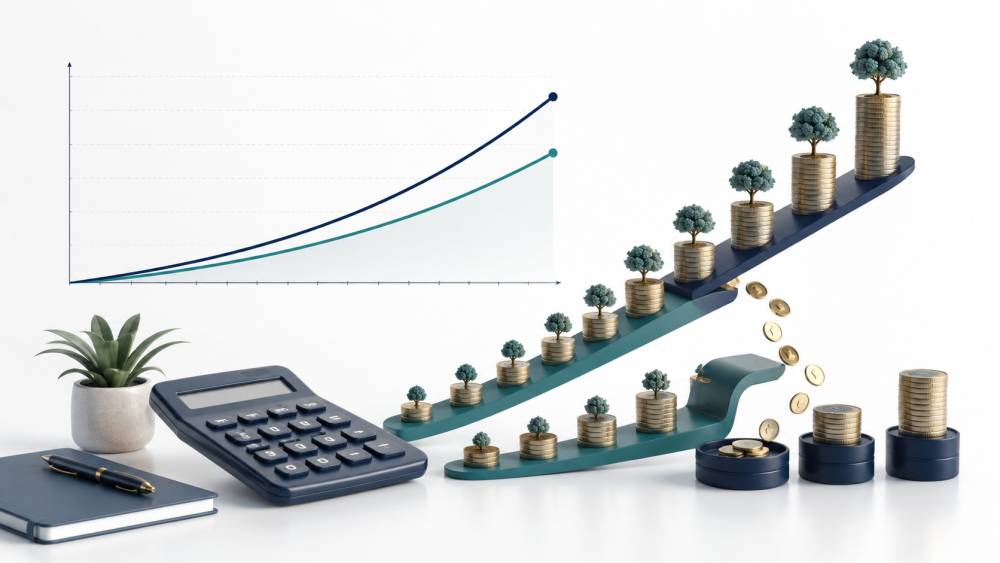
This distinction becomes more important over long periods. A fee paid near the beginning of a 30-year projection has many years in which its missed returns can compound. That is why a seemingly modest annual percentage can create a much larger difference in the final balance.
Why Small Fee Differences Matter
Costs are only one part of an investment decision, and the lowest-fee choice is not automatically the best choice. Investment strategy, risk, diversification, taxes, services received, and performance can all matter. However, fees are one of the factors an investor can identify in advance, and they directly reduce the return the investor keeps.
When comparing two investments, use consistent assumptions. Enter the return before fees for both scenarios, then change only the fee inputs. This isolates the cost difference instead of mixing fee effects with different performance forecasts.
Calculation Assumptions
The calculator converts the gross annual return and combined percentage-based fee to monthly-equivalent rates. Fixed annual fees are spread across twelve monthly deductions, and recurring contributions are added at the end of the selected contribution interval. The model assumes a steady rate of return for illustration; actual market returns change over time.
The results do not include taxes, trading commissions, bid-ask spreads, sales loads, early withdrawal penalties, inflation, or changes in fees. They are estimates for educational and planning purposes, not predictions or investment advice.
Frequently Asked Questions
Where can I find a fund’s expense ratio?
Look in the fund prospectus, shareholder report, brokerage research page, or official fund fact sheet. Use the current net expense ratio when that is the cost presently charged, and review whether a temporary fee waiver applies.
Should I enter both an expense ratio and an advisory fee?
Yes, if your account pays both. The expense ratio covers costs inside the fund, while the advisory fee pays for portfolio management or advice. The calculator combines the two percentage-based charges while showing the fixed annual charge separately.
What return should I enter?
Enter an estimated annual return before the fees included elsewhere in the calculator. Consider testing conservative, moderate, and optimistic assumptions rather than relying on a single forecast.
Does the calculator predict actual investment performance?
No. It demonstrates how the entered fee structure affects a hypothetical constant-return projection. Actual investments can gain or lose value, returns are uneven, and fees may change.
Can a higher fee ever be worthwhile?
Possibly. A higher fee may pay for advice, planning, tax management, specialized exposure, or other services an investor values. This calculator measures the projected cost so that the benefit required to justify that cost is easier to evaluate.