
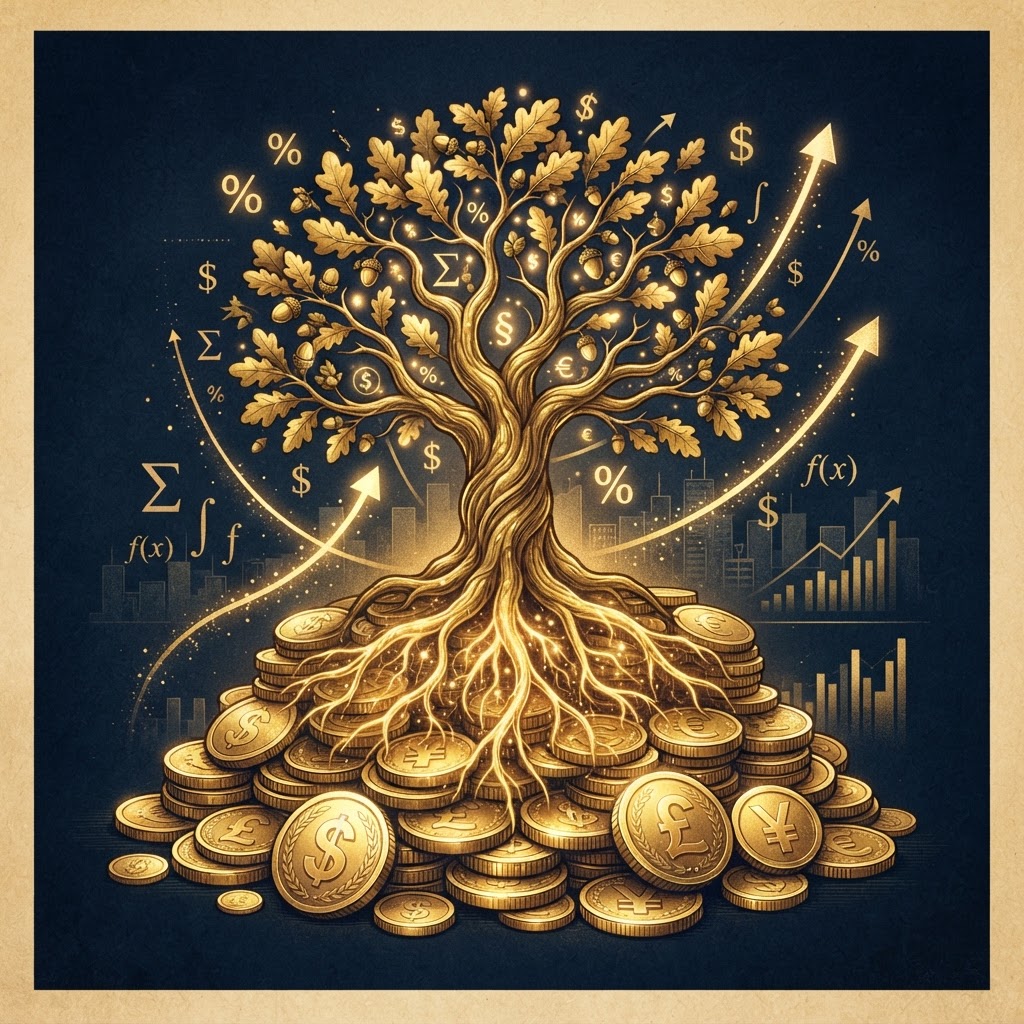
If you have ever wondered why some investors end up with seven-figure portfolios on middle-class incomes while others earn the same salary their whole lives and retire with almost nothing, the answer is almost never income. It is almost always the engine they built — or failed to build — through compound interest. Compounding is not magic. It is mechanical. And like any engine, it runs reliably only when it has the right components, the right fuel, and consistent operation. Let us break down exactly how to build a portfolio that compounds hard enough to outlive you.
Component One: Capital Is the Fuel
The first thing compounding needs is capital. This seems obvious, but the size of the capital is far less important than people think. What matters is that capital keeps arriving. The investor who consistently puts in $200 a month for 40 years will end up with more than the investor who waits 10 years and then tries to catch up with $600 a month. The reason is mathematical. Early dollars have more time to compound, and time is what transforms small contributions into large balances.
The most reliable way to keep capital flowing into your portfolio is automation. Human willpower is unreliable, especially when markets are falling. Set up an automatic transfer from your checking account to your investment account the day after payday. Treat it like rent or a utility bill. The money leaves before you can spend it on something else. After a few months, you stop noticing the deduction. After a year, you have a growing portfolio that required zero willpower to build.
Component Two: Time Is the Multiplier
Time is the variable that turns modest capital into extraordinary wealth. A 7% annual return doubles your money roughly every 10 years. A dollar invested at 25 has 40 years to double four times, becoming about $16 at 65. A dollar invested at 45 has only 20 years, becoming about $4. Same dollar, same return, one quarter the result. The difference is entirely time.
This is why the most expensive mistake in personal finance is not market timing or stock picking. It is waiting to start. Every year you delay costs you a full doubling cycle at the front end of your compounding curve, where each doubling has the most time to multiply further. The investor who starts at 25 and stops at 35 will typically outperform the investor who starts at 35 and invests until 65. The first investor let their money compound for 30 additional years, and 30 years of compounding beats 30 years of contributions.
Component Three: Discipline Is the Engine
Compounding only works if you do not interrupt it. Every time you sell during a downturn, every time you pause contributions because the market is volatile, every time you cash out to fund a lifestyle upgrade, you break the engine. The investor who simply does nothing through market cycles — who keeps buying through crashes and keeps holding through booms — is the one who captures the full power of compounding.
Discipline is easier when you understand what market volatility actually is. A 30% drop in your portfolio feels catastrophic, but historically the market has recovered from every single crash and gone on to new highs. The investor who sold at the bottom of the 2008 crash locked in a permanent loss. The investor who kept buying through 2008 and 2009 ended up with dramatically more money by 2015 than the investor who sat in cash. Volatility is the price of admission for long-term returns. Pay the price and stay in your seat.
Why Index Funds Are the Engine Block
The actual investments you hold are the engine block of your compounding machine. Most investors overthink this. The research is overwhelming: low-cost, broadly diversified index funds outperform the majority of actively managed funds over long periods. The reason is fees. A 1% annual fee, compounded over 40 years, eats about 30% of your final balance. A 0.05% index fund fee barely registers.
A total stock market index fund or S&P 500 index fund gives you instant diversification across hundreds of companies at a near-zero cost. You are not betting on one company or one sector. You are betting on the long-term growth of the broad economy, which has been a reliable bet over every 20-year period in modern market history. Add a small bond allocation as you approach retirement, keep the stock allocation high while you are young, and rebalance once a year. That is the entire engine.
The Numbers, Made Concrete
Let us put real numbers on this. Suppose you invest $400 a month from age 25 to age 65 in a total stock market index fund, earning an average 8% annual return. Your total contributions are $192,000. Your final balance is approximately $1.4 million. Compound interest generated $1.2 million of that. Your money worked six times harder than you did.
Now suppose you wait until 35 to start, but you invest $600 a month — 50% more — to try to catch up. By 65, you have contributed $216,000, and your balance is approximately $1.04 million. You invested more money and ended up with less. The 10 missing years cost you about $360,000 in final wealth, which is more than you contributed in the first 25 years of the second scenario. That is the cost of waiting, expressed in dollars.
The Engine Never Stops
The most beautiful feature of a compounding portfolio is that the engine does not stop when you retire. In fact, the second half of compounding — the withdrawal phase — is where many investors either secure their lifetime income or quietly run out of money. A portfolio that has been built with sufficient capital, decades of time, and consistent discipline enters retirement with enough mass to keep generating returns even as you withdraw from it. The engine simply shifts from accumulation mode to distribution mode, and compounding continues to work, just at a slower rate.
Building a portfolio that outlives you is not a matter of luck or genius. It is a matter of understanding the three components and assembling them in the right order. Start with capital, no matter how small. Give it as much time as you possibly can. Maintain discipline through every market cycle. Let the engine do what it does. The math takes care of the rest, and it never gets tired, never panics, and never stops working — for as long as you let it.