
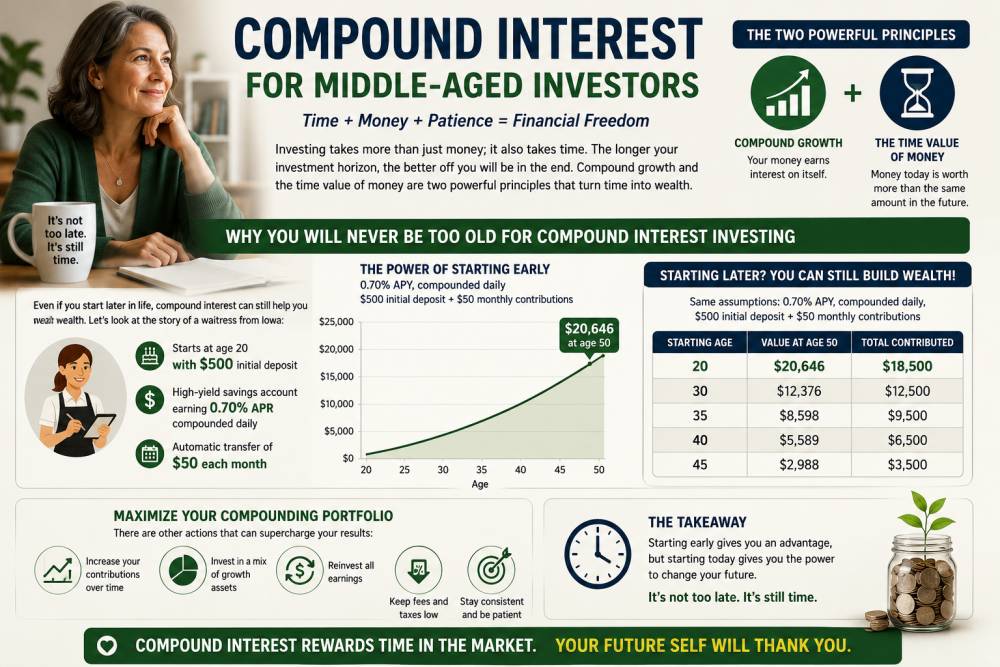

Investing takes more than just money; it also takes time, and the longer your investment horizon is, the better off you will be in the end. There are two personal finance principles that clearly explain the nexus of time and money as it relates to investment success: compound growth and the time value of money. We are going to discuss these two concepts in order to better understand how compounding can work in favor of investors even if they start later in life.
Why You Will Never be Too Old for Compound Interest Investing
Financial gurus such as Suze Orman will always tell you that one of the keys to achieving financial freedom is to start saving and investing when you are young. Let’s say a waitress from Iowa starts compounding when she is 20 years old with $500 deposited into a high-yield savings account that pays 0.70% interest that compounds on a daily basis. If on top of this she sets up an automatic transfer of $50 each month, she would have $20,646 in her account by the time she turns 50. This may not sound like much, but it does not include other actions that this waitress can take to maximize her compounding portfolio; we will discuss those a little later.
Let’s change the scenario above to reflect our Iowa waitress at the age of 50. She has not saved up for retirement, so she is looking at a “now or never” situation. Using the same financial parameters, the balance of her compounding account would be $10,044 by the time she hits the retirement age of 65. Once again, it may not seem like much, but it is $10,044 more than what the waitress would have when she is getting ready to retire. The bottom line is that $20,646 at age 50 is a lot better than $10,044 at age 65.
Making Up For Lost Time
What you need to do in your 50s will need to be different than what you should have done in your 20s. Getting back to our young waitress, we did not mention that she would have saved up $32,421 at age 65 with her simple plan of starting out with $500 and depositing $50 each month. Compound interest would take care of the rest because her earnings would be automatically reinvested, but she does not have to limit herself to the same $50 contributions each month.
Compounding is an exponential investment strategy; as such, it will always work better with larger and more frequent contributions. Our waitress should not limit herself to making the same monthly deposit each month for the rest of her life; for better results, she could either commit to increasing her contributions or perhaps get into stock investing for the purpose of maximizing the potential of her compound interest account. She can do this gradually because she has the advantage of being a young investor.
When we talk about a 50-year-old waitress who is just now getting into investing, she does not have the luxury of youth, so her investment horizon is a lot shorter. In this situation, making up for lost time means throwing everything possible into a compound interest portfolio. Although it is better to stay conservative with assets such as certificates of deposit and bonds, stock investing should not be out of the question as long as it is handled by a financial planner.
At the age of 50, you still have a decade and a half before reaching retirement age. Whatever you earn now will be worth less in the future; this is what the time value of money entails, and you need to counter it with a sound investing strategy such as compounding. Just keep in mind that it is never too late to get started.