

Interest is one of the most important forces in personal finance and investing. Whether someone is saving money, investing in markets, or borrowing funds, understanding how interest works can make a significant difference in long-term financial outcomes. Two of the most commonly discussed types are simple interest and compound interest. While they may sound similar, the way they function — and the results they produce — are very different.
Knowing how each type works helps individuals make smarter decisions about savings accounts, loans, investments, and financial planning strategies.
What Is Simple Interest?
Simple interest is calculated only on the original principal amount of an investment or loan. This means the interest earned or owed remains consistent over time because it does not take previously earned interest into account.
For example, imagine an individual invests $10,000 at a simple interest rate of 5% per year. Each year, the investment earns $500. After five years, the total interest earned would be $2,500. The balance would grow to $12,500.
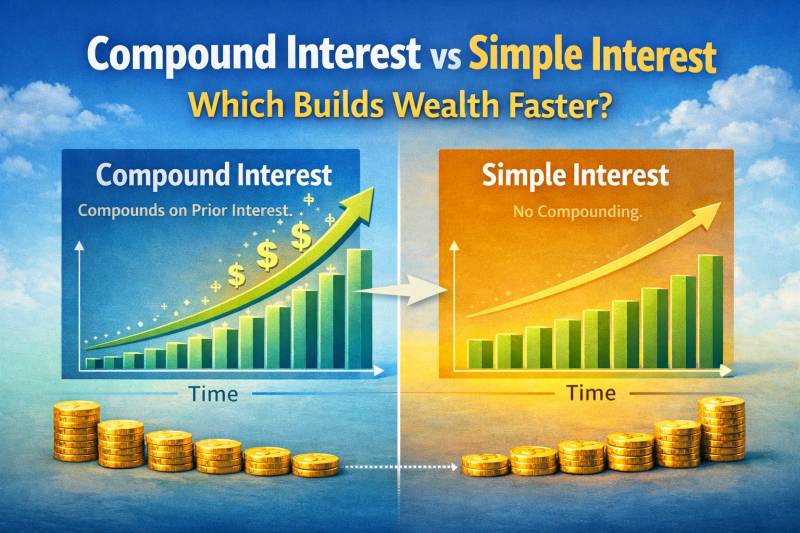
The key characteristic of simple interest is predictability. Growth occurs in a straight line rather than accelerating over time. Because interest does not compound, the total gain is limited to a fixed percentage of the original amount.
Simple interest is commonly used in short-term loans, certain bonds, and some basic financial agreements where straightforward calculations are preferred.
What Is Compound Interest?
Compound interest works differently. Instead of calculating interest only on the original principal, it also includes interest that has already been earned. This creates a layering effect where gains begin to generate additional gains.
Using the same $10,000 example with a 5% annual rate, compound interest would result in a higher total balance after five years. In the first year, the investment earns $500, bringing the balance to $10,500. In the second year, interest is calculated on $10,500 instead of the original $10,000.
As time passes, the gap between simple interest and compound interest becomes increasingly noticeable. The growth curve starts slowly but gradually becomes steeper.
This acceleration is what makes compound interest such a powerful financial mechanism.
Visualizing the Difference Over Time
In the early stages, simple and compound interest may appear almost identical. Over one or two years, the difference in returns may be small enough to overlook. However, the longer the time horizon, the more dramatic the divergence becomes.
Consider a 20-year investment period. With simple interest, gains continue to increase at the same steady pace. With compound interest, gains begin to multiply because each year builds upon the last.
After several decades, compound growth can result in balances that are significantly higher than those achieved through simple interest. This is why long-term investors often emphasize the importance of starting early and remaining consistent.
Time becomes one of the most valuable components in the compounding equation.
The Impact of Compounding Frequency
Compound interest can be calculated at different intervals, such as annually, quarterly, monthly, or daily. The more frequently interest is added to the balance, the faster growth can occur.
Daily compounding, for example, allows earnings to begin generating new earnings almost immediately. While the difference between monthly and daily compounding might seem minor at first glance, the cumulative effect over many years can be meaningful.
This frequency factor is often highlighted in savings products, investment funds, and certain financial instruments designed to maximize growth potential.
Understanding how often interest compounds is just as important as knowing the interest rate itself.
Real-World Investment Example
Imagine two individuals who each invest $20,000 at a 7% annual rate. One investment uses simple interest, while the other compounds annually.
After 15 years, the simple interest investment produces steady but limited growth. The compound interest investment, on the other hand, benefits from reinvested gains each year. By the end of the period, the compound account balance can be thousands of dollars higher.
If additional contributions are made regularly, the advantage becomes even more pronounced. Compounding works on every deposit, allowing the entire portfolio to accelerate.
This principle explains why retirement accounts and long-term investment portfolios often rely heavily on compound growth strategies.
When Simple Interest Can Be Useful
Although compound interest is typically more powerful for building wealth, simple interest still has practical uses.
Borrowers may benefit from simple interest loans because repayment amounts remain predictable. There is less risk of balances growing rapidly due to accumulated interest. This can make budgeting easier and reduce financial stress.
Short-term investments may also use simple interest structures because the compounding advantage has limited time to take effect. In these situations, simplicity and transparency can be more valuable than growth optimization.
Financial products are often designed with specific purposes in mind, and the interest structure reflects those goals.
Behavioral Factors and Wealth Growth
One reason compound interest builds wealth faster is that it encourages long-term thinking. Investors who understand compounding are more likely to stay invested, reinvest earnings, and avoid unnecessary withdrawals.
Simple interest, while easier to calculate, does not provide the same psychological incentive to remain patient. Since growth is linear, progress can feel slower and less motivating.
Compound growth introduces a visible acceleration that can reinforce disciplined financial habits. Seeing gains increase year after year often strengthens confidence in long-term strategies.
Consistency, combined with compounding, can transform modest contributions into meaningful financial resources over time.
Strategic Use of Both Interest Types
Smart financial planning often involves using both simple and compound interest strategically.
For example, an individual might prioritize paying off high-interest compound debt while placing savings into compound-growth investments. At the same time, they may choose simple interest financing for certain purchases where predictability is important.
Balancing these approaches allows for flexibility and control. Rather than viewing simple and compound interest as competing concepts, they can be understood as tools suited for different situations.
As financial literacy improves, individuals can begin making more intentional choices about where their money works hardest and how growth mechanisms influence long-term outcomes. 📊