
I have answered some version of this question more times than I can count. How much should I be investing? Is $100 a month enough? Should I be doing $500? What does the rule say?
Here is the honest answer, the one that most financial content online does not give you: there is no universal right number. The right monthly investment amount is deeply personal. It depends on your age, your income, your existing assets, your expenses, your risk tolerance, your goals, and a dozen other variables that a generic internet article simply cannot account for. What I can give you, after 30 years of sitting with real clients and working through real numbers, is a framework — a way of thinking about this question that will help you arrive at a number that is right for you, and not just for some hypothetical average person.
Start With the 15% Guideline — But Understand Its Limits
The most commonly cited rule is to invest 15% of your gross income for retirement. If you earn $60,000 per year, that means $9,000 per year, or $750 per month. This rule is not wrong — in fact, for many people in their 30s who are starting with a reasonable time horizon and no significant existing savings, 15% is a solid baseline. But it is a starting point, not a destination.
The 15% figure assumes you start investing in your mid-20s to early 30s, earn a market return in the range of 7-8% annually, and want to replace roughly 70-80% of your pre-retirement income. Change any one of those assumptions and the right number changes significantly.
If you are 40 and starting from scratch, 15% is almost certainly not enough. If you are 25 and already have a meaningful employer match in your 401(k), 15% might actually be more than you need. Context matters enormously, and I have seen clients run into trouble by following the 15% rule without understanding the assumptions behind it.
The Employer Match: The Most Valuable Dollar in Investing
Before we talk about how much you should invest beyond your basic expenses, let me say this unequivocally: if your employer offers a 401(k) match and you are not capturing the full match, you are leaving free money on the table. This is the single highest-return investment available to most working Americans, and I have seen people walk away from tens of thousands of dollars over their careers because they did not understand this.
A typical employer match is 50 cents for every dollar you contribute, up to 6% of your salary. On a $60,000 salary, that means contributing $3,600 per year gets you an additional $1,800 from your employer. That is an instant 50% return on your money before the market does anything at all. Step one, always, is to contribute at least enough to capture the full employer match. Full stop. Non-negotiable. This is the foundational first rule of personal investing, and I have never once recommended that a client deviate from it.
Building Your Number From the Ground Up
Once you have the match covered, the question becomes: how much more? Here is the framework I use with clients. First, calculate your monthly take-home pay after taxes and any pre-tax deductions like health insurance. Then identify your fixed essential expenses — rent or mortgage, utilities, insurance, car payment, minimum debt payments, and groceries. Subtract essentials from take-home. What remains is your discretionary cash flow.
From that discretionary pool, your investment contributions should be the first priority — not an afterthought. I recommend clients treat their investment transfer like a bill, not a choice. Once you have paid your essentials, you pay your future self. Then you live on what remains.
A reasonable target for most working adults is to invest somewhere between 15% and 25% of gross income, with higher percentages appropriate for later starters, higher earners, or those with ambitious early-retirement goals. If you are starting at 22 with no debt, 15% might build extraordinary wealth. If you are starting at 42 with nothing saved, 25-30% is not extreme — it may be necessary.
The Power of Small Numbers Compounded Over Time
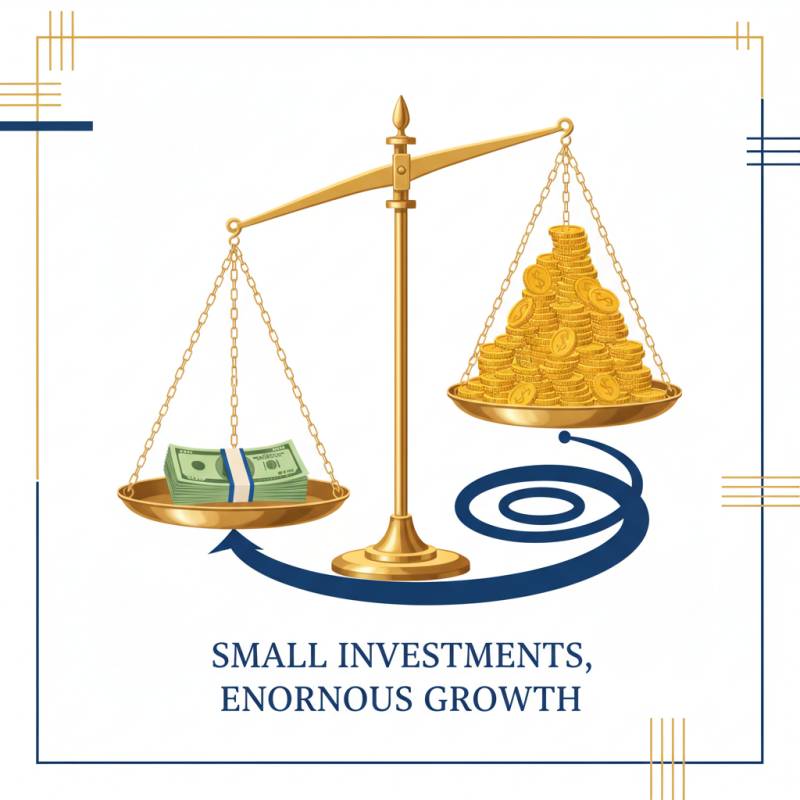
One of the most important things I have learned over 30 years is that people consistently underestimate what small amounts can become over long time horizons. They think $100 a month is not worth the effort. They are wrong. Profoundly, mathematically wrong.
$100 per month invested at 8% annually from age 25 to age 65 grows to approximately $349,000. You contributed $48,000 of your own money. The remaining $301,000 was generated by compound interest. You made more than six times what you put in — while earning a salary, living your life, and doing nothing else. That is the quiet power of consistency over time.
Now double it to $200 per month. You get approximately $698,000. Double it again to $400 per month: $1.4 million. The relationship is linear with your contribution, but exponential with time. This is why I always tell clients who say they cannot afford to invest much: it is better to invest $50 per month for 40 years than $500 per month for 5 years. Time is the multiplier that no amount of money can buy back.
Adjusting as Life Changes
The right investment amount is not static. It should grow with you. I encourage clients to commit to what I call a “pay-raise pledge” — every time they receive a raise or promotion, a predetermined percentage of that raise goes directly to increasing their investment contribution. If you get a $400-per-month raise and immediately redirect $200 of it to investments before you adjust your lifestyle, you will never miss it, because your spending never expanded to claim it.
This strategy has produced more wealth for my clients over the years than almost any investment decision I have made for them. It leverages human inertia in the right direction: instead of lifestyle inflation eating your raises, your investment account quietly captures them year after year.
Getting Specific With Your Own Numbers
The most valuable thing I can encourage you to do today is to run your own numbers. Use a tool like our Compound Interest Calculator to model what your current monthly contribution becomes over 10, 20, and 30 years. Then run the scenario of increasing your contribution by just $50 or $100 per month, and see how dramatically that changes the outcome. The numbers will tell you more convincingly than I ever can that the monthly amount matters — and that even modest increases, sustained over time, produce extraordinary results. Your future self is depending on the decisions you make today.