
Albert Einstein — though historians debate whether he actually said this — is often quoted as calling compound interest the “eighth wonder of the world.” Whether or not Einstein said it, the sentiment is mathematically accurate. Compound interest is, without question, the most powerful non-physical force in personal finance. And yet, in 30 years of financial planning, I have found that the vast majority of people — including many intelligent, educated, financially curious people — understand compound interest only at a surface level.
They know it means “interest on interest.” They know it is good. They know starting early helps. But they do not truly feel the mathematics in their bones. They have not internalised why compound interest is not just good, but transformatively, life-changingly powerful — and why understanding it deeply should alter the financial decisions you make every single day.
Let me fix that today.
Simple Interest vs. Compound Interest: The Fork in the Road
To understand why compound interest is remarkable, you first need to understand what it is competing against. Simple interest is the baseline: you earn interest only on your original principal. If you invest $10,000 at 8% simple interest, you earn $800 per year. Every year. Forever. After 30 years, you have earned $24,000 in interest and your account holds $34,000.
Compound interest works differently. Each year, the interest you earned in the previous year is added to your principal, and then the new, larger total earns interest. In year one at 8%, you earn $800 on your $10,000 — same as simple interest. But in year two, you earn 8% on $10,800, which is $864. In year three, you earn 8% on $11,664, which is $933. The number you are earning interest on keeps growing, which means the interest payment itself keeps growing, which means the principal grows faster, which earns more interest.
After 30 years of compound interest at 8%, your $10,000 has grown to approximately $100,627. You made nearly three times as much as with simple interest. You did not work harder. You did not take more risk. You did not make a single additional contribution. The only thing that changed was the mathematical structure of how your interest was calculated. That is the power of compounding.
The Snowball on the Mountain
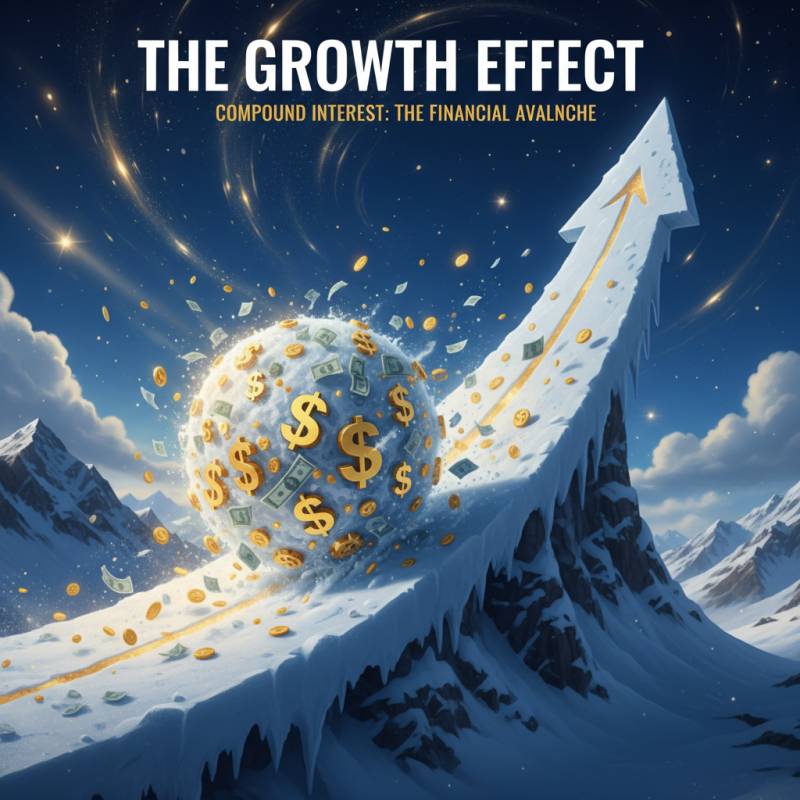
The best metaphor I have ever found for compound interest is a snowball rolling down a long mountain. When you first push the snowball, it is small, and it picks up very little snow with each rotation. Progress is slow and barely perceptible. This is what the early years of a compounding investment feel like — and it is precisely why so many people give up or lose faith. They do not see dramatic growth in years one through five, and they conclude that compounding is not working.
But the snowball does not stop. As it rolls, it gets marginally larger, and a larger snowball picks up more snow per rotation than a smaller one. The growth rate of the snowball accelerates as the snowball itself grows. By the time it reaches the bottom of a long mountain, it is not twice the size or ten times the size — it may be a hundred times the size of the original snowball, and it is moving fast.
This is why financial planners are so obsessive about time horizons. The bottom of the mountain — the last decade before retirement — is where the extraordinary wealth is built. The first decade of investing is just getting the snowball moving. The last decade is where it becomes an avalanche. Clients who cash out early, who pause contributions during difficult years, or who delay starting until their 40s are essentially cutting the mountain short at the most critical point.
Compounding Frequency: Daily vs. Monthly vs. Annual
Most people think of compound interest as an annual event, but in practice, the frequency of compounding matters significantly. The more frequently interest is compounded, the faster your money grows — and the difference becomes substantial over long time horizons.
Consider $50,000 invested at 8% annual interest over 20 years. With annual compounding, you end up with approximately $233,050. With monthly compounding, you end up with approximately $244,900. With daily compounding, approximately $246,000. The difference between annual and daily compounding on a $50,000 investment over 20 years is nearly $13,000 — and that gap widens significantly with larger principals and longer time horizons.
This is why the type of account and investment vehicle you choose matters. High-yield savings accounts, for example, typically compound daily. Many bonds compound semi-annually. Understanding the compounding frequency of your specific investments is part of making informed decisions — and it is one of the details that gets glossed over in most financial education.
The Rule of 72: A Mental Shortcut Every Investor Should Own
One of the most practical tools I give clients for quickly estimating compound growth is the Rule of 72. Divide 72 by your annual interest rate, and the result tells you approximately how many years it will take to double your money.
At 6%, your money doubles every 12 years. At 8%, every 9 years. At 10%, every 7.2 years. At 12%, every 6 years. This simple formula has enormous practical value. A 30-year-old investing at 8% sees their money double at 39, again at 48, again at 57, and again at 66. Four doublings. If they started with $50,000, that becomes $800,000 at 66 — just from the original investment, with no additional contributions. Add monthly contributions to the equation and the numbers become extraordinary.
The Hidden Threat: Compound Interest Working Against You
Here is the part of this lecture that I consider the most important, the part I wish more financial educators would emphasise: compound interest does not distinguish between friend and foe. It works just as powerfully against you when you carry debt as it works for you when you invest.
A credit card charging 22% annual interest, if left unpaid, will double the balance you owe in approximately 3.3 years. A $5,000 credit card balance not addressed becomes $10,000 in 3 years. It becomes $20,000 in 6 years. It becomes $40,000 in 9 years — from a $5,000 starting point. I have seen this exact scenario play out for clients, and it is financially devastating in a way that is difficult to recover from without dramatic intervention.
This is why one of my first priorities with new clients who carry high-interest consumer debt is to eliminate it before optimising investments. You cannot out-invest 22% guaranteed compounding working against you. Pay off the credit cards. Then invest with the same ferocity you used to attack the debt.
Making Compound Interest Work Hardest for You
After 30 years, here is my distilled advice for maximizing the power of compound interest in your financial life. Start as early as possible — the time horizon is the single most important variable. Contribute consistently — irregular investing destroys the compounding curve. Reinvest all dividends and interest rather than withdrawing them. Minimize fees — a 1% annual management fee, compounded over 30 years, can consume 25-30% of your final portfolio. Use tax-advantaged accounts like IRAs and 401(k)s to prevent taxes from interrupting the compounding cycle. And use tools like our Compound Daily Calculator to visualize your specific numbers — because seeing your own money compound on a real chart is more motivating than any lecture I can give.
Compound interest is patient, indifferent, and relentlessly mathematical. It does not care about your feelings or your market predictions. It simply does its job, year after year, doubling and re-doubling your wealth in the background while you live your life. Your only job is to start early, stay consistent, and let time do the rest.