
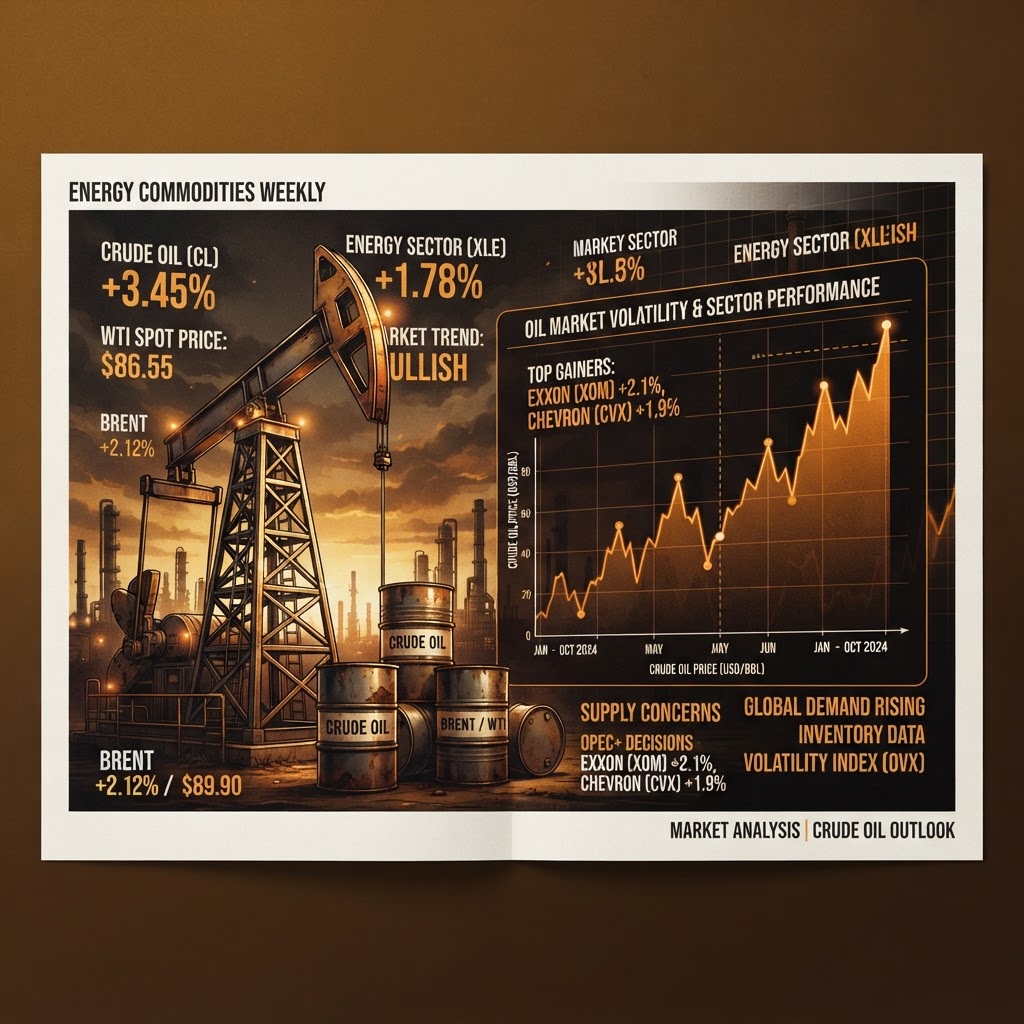
Crude oil is the most heavily traded commodity in the world and one of the most economically significant prices on the planet. The price of oil directly affects the cost of transportation, manufacturing, heating, and electricity, which means it ripples through virtually every sector of the economy. For investors, oil’s price movements are not just relevant to energy stocks. They affect inflation, which affects interest rates, which affects every asset class. They affect the dollar, which affects commodities and multinational earnings. They affect consumer spending, which affects corporate profits. Understanding the oil market and its transmission to other assets is essential for any investor who wants to read the market comprehensively.
The Two Crude Benchmarks
The global oil market has two primary benchmarks — West Texas Intermediate, or WTI, which is the US benchmark, and Brent, which is the international benchmark. The two typically trade within a few dollars of each other, but the spread between them is informative. When Brent trades at a significant premium to WTI, it typically signals that global demand is strong relative to US supply, or that there are constraints on moving US oil to international markets. When the spread narrows, it signals that the two markets are more balanced. For investors reading the oil market, both benchmarks matter, and the spread between them provides useful information about global versus domestic supply-demand dynamics.
The price of oil is determined by the balance between global supply and demand, and both sides of that balance are influenced by a complex set of factors. On the supply side, the most important actors are OPEC+, which is the cartel of oil-producing countries that coordinates production levels, and the United States, which is now the world’s largest oil producer thanks to the shale revolution. On the demand side, the most important driver is global economic growth, particularly in China, India, and other rapidly developing economies that consume increasing amounts of energy as they industrialize.
OPEC and the Supply Lever
OPEC+ controls roughly half of the world’s oil production capacity and has historically been the most important influence on the oil price. The cartel meets regularly to set production targets, and its decisions can move the oil price significantly. When OPEC cuts production, it tightens supply and supports the price. When OPEC increases production, it loosens supply and pressures the price. The dynamics within OPEC are complex, because member countries have different interests and incentives, and compliance with production targets is often incomplete.
The most important member of OPEC is Saudi Arabia, which is the largest producer and the swing producer that has historically adjusted its output to manage the price. Saudi Arabia’s production decisions are influenced by its fiscal needs, its long-term strategy, and its relationship with other producers, particularly Russia, which is part of the OPEC+ coalition but is not an OPEC member. For investors reading the oil market, Saudi production decisions are among the most important variables to watch, because they often set the direction of the entire market.
US Shale and the Supply Response
The rise of US shale production has fundamentally changed the global oil market over the past 15 years. The United States is now the world’s largest oil producer, and shale production is more responsive to price signals than traditional production, because shale wells can be brought online relatively quickly when prices are attractive and shut down when prices are low. This responsiveness has made the oil market more dynamic and has reduced the ability of OPEC to sustain high prices through production cuts alone, because shale producers can increase output to capture the higher prices.
The breakeven price for shale production — the price at which it becomes profitable to drill new wells — is an important number for investors. When the oil price is well above the shale breakeven, production expands rapidly, which eventually pressures the price. When the price is near or below the breakeven, production contracts, which eventually supports the price. This dynamic creates a natural mean reversion in the oil price, which tends to oscillate around the marginal cost of production over longer periods. For investors reading the oil market, US shale production trends and rig counts provide a useful read on the supply response.
The Inflation Transmission
One of the most important channels through which oil affects the broader market is inflation. Oil is a significant component of the consumer price index, both directly through gasoline and heating fuel and indirectly through transportation costs that affect the price of virtually every good. When the oil price rises sharply, it puts upward pressure on inflation, which can force the Federal Reserve to raise interest rates, which pressures asset valuations across the board. When the oil price falls, it relieves inflationary pressure, which can allow the Fed to cut rates, which supports asset valuations.
This transmission is one reason why oil price spikes are often associated with broader market stress. A sharp rise in oil prices acts as a tax on consumers, transferring wealth from oil consumers to oil producers and reducing discretionary spending. This pressures consumer-facing businesses and can tip a fragile economy into recession. Conversely, a sharp fall in oil prices acts as a tax cut for consumers, boosting discretionary spending and supporting economic growth. For investors reading the market, the oil price is not just an energy sector indicator. It is a macroeconomic indicator with broad implications.
Energy Stocks and the Broader Market
The energy sector is a significant component of the S&P 500, typically representing around 4% to 5% of the index, and energy stocks are among the most directly correlated with the oil price. When oil rises, energy stocks typically outperform, and when oil falls, energy stocks typically underperform. Within the energy sector, there is a distinction between upstream companies, which produce oil and gas and benefit directly from higher prices, and downstream companies, which refine and distribute petroleum products and can benefit from lower crude prices as input costs.
Beyond the energy sector, oil prices affect a wide range of industries. Transportation companies, particularly airlines, are highly sensitive to fuel costs. Chemical companies use petroleum as a feedstock. Manufacturing companies depend on energy for production. Each of these sectors responds differently to oil price movements, and reading the cross-sector response provides useful information about how the market is interpreting oil price changes. When energy stocks are rising while transportation and consumer stocks are falling, the market is signaling that oil price strength is being interpreted as a headwind to the broader economy rather than as a positive for energy earnings.
How to Read the Oil Market for Investment Decisions
For most investors, the practical takeaway is that oil is a macroeconomic input that affects far more than the energy sector. Reading the oil market requires watching OPEC decisions, US production trends, global demand indicators, and the dollar, which together determine the price. The price, in turn, affects inflation, interest rates, the dollar, consumer spending, and corporate earnings, which together determine how the broader market responds.
The most important discipline is to avoid treating oil as a simple directional bet. Oil is a complex market with its own supply-demand dynamics, and its price movements have different implications for different assets at different times. A rising oil price is good for energy stocks and bad for transportation stocks, good for oil-producing countries and bad for oil-consuming countries, supportive for inflation and potentially negative for bonds. Reading the oil market means understanding these cross-currents and interpreting what the price is signaling about the global economy. The investors who read the energy market comprehensively, rather than simply trading the oil price, are the ones who extract the most information from one of the most economically significant prices in the world.