
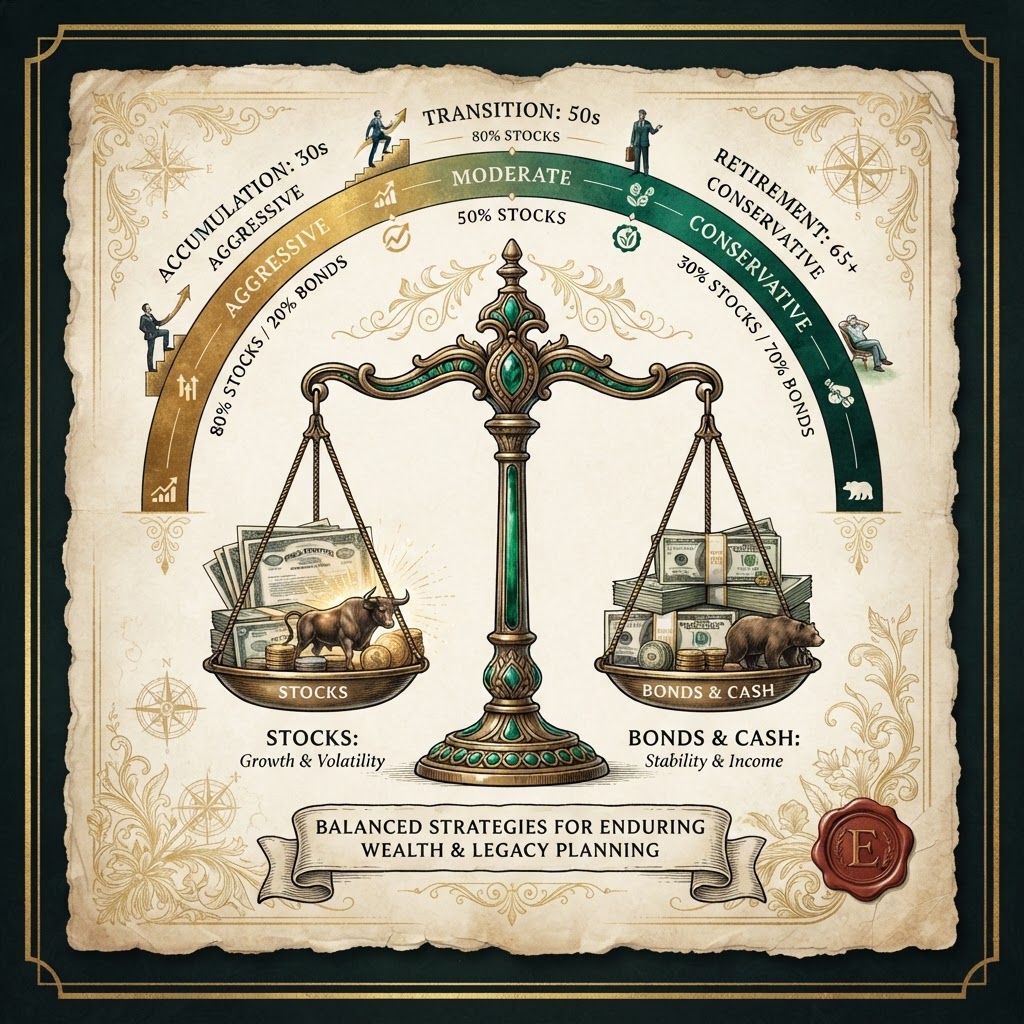
The shift from accumulating wealth to living off it is not a light switch. It is a rebalancing act that takes years, and it is one of the most under-discussed topics in personal finance. Most investors focus their entire lives on the accumulation phase — how much to save, what to buy, when to start — and arrive at retirement with no plan for the transition. The result is often one of two extremes. Either they panic and move everything to cash, sacrificing growth and losing ground to inflation. Or they stay fully invested in stocks, taking on dangerous volatility at exactly the wrong time. The right answer is somewhere in between, and it is called the glide path.
What Is a Glide Path?
A glide path is a planned, gradual shift in your asset allocation over time. The name comes from aviation. A plane does not drop out of the sky when it reaches its destination. It follows a smooth descending curve to a safe landing. Your portfolio should do the same thing. You do not go from 100% stocks to 100% bonds overnight. You glide.
Target-date funds, which are the default investment option in most 401(k) plans, are built around this concept. A target-date fund dated 2065 will be heavily weighted toward stocks today. As 2065 approaches, the fund automatically shifts more of its holdings into bonds and cash. The shift happens gradually, on a predetermined schedule, without any action required from you. But understanding what is happening under the hood matters, because the difference between a good glide path and a bad one can be hundreds of thousands of dollars.
The Classic Glide Path Formula
One of the oldest and simplest glide path rules is to subtract your age from 110 or 120, and put that percentage of your portfolio in stocks. At age 25, that means 85% to 95% in stocks. At age 65, that means 45% to 55% in stocks. The rest goes into bonds and cash. The exact number you subtract from matters less than the principle, which is that your stock allocation should decline as your time horizon shortens and your portfolio grows.
Modern glide paths are more sophisticated. They typically hold a high stock allocation, often 90% or more, well into your 40s, because the time horizon is still long enough to absorb volatility. The shift toward bonds accelerates in your 50s and 60s, when the size of your portfolio makes a market crash much more dangerous in dollar terms. A 30% drop on a $20,000 portfolio is recoverable. A 30% drop on a $1 million portfolio right before retirement can be devastating.
Why Young Investors Should Care About the Glide Path Now
You might be in your 20s or 30s and wonder why the glide path matters yet. It matters for two reasons. First, knowing the destination helps you make better decisions along the way. If you understand that your portfolio will gradually become more conservative, you will not panic when your target-date fund starts shifting into bonds. You will know it is supposed to do that. Second, the glide path teaches you one of the most important lessons in investing, which is that risk tolerance is not a fixed personality trait. It changes with your circumstances.
A young investor with a small portfolio and decades of earnings ahead can afford to take a lot of risk. The same investor at 60, with a large portfolio and only a few years of earnings left, cannot. This is not cowardice. It is prudence. The cost of a market crash is asymmetric at different life stages. When you are young, a crash is a buying opportunity. When you are old, a crash is a permanent loss. The glide path exists to manage that asymmetry.
How to Build Your Own Glide Path
If you want to manage your own portfolio instead of using a target-date fund, the glide path is straightforward to implement. Start with 90% to 100% in stocks through your 20s and 30s. Use a total stock market index fund or a combination of US and international stock funds. In your 40s, begin adding a bond fund, aiming for roughly 10% to 20% in bonds by age 50. In your 50s, accelerate the shift, targeting 30% to 40% in bonds by age 60. By retirement, land somewhere between 40% and 60% in stocks, with the rest in bonds and cash.
The exact numbers are less important than the discipline of the shift. The biggest mistake self-directed investors make is not adjusting their allocation as they age. They build a stock-heavy portfolio in their 30s, get comfortable with it, and never change it. Then a crash hits in their early 60s and they lose years of progress right before retirement. The glide path is the antidote. It is a calendar reminder that your portfolio should age with you.
How Rebalancing Builds the Glide Path Naturally
There is a beautiful thing that happens when you rebalance your portfolio once a year. You naturally sell what has done well and buy what has done poorly, which is the opposite of what your instincts tell you to do. When stocks have had a great run, your stock allocation will be above your target. Rebalancing means selling some stocks and buying bonds to bring the allocation back in line. When stocks have crashed, your stock allocation will be below your target. Rebalancing means selling some bonds and buying stocks at the bottom.
This annual rebalancing, combined with a gradually declining target stock allocation, builds the glide path automatically. You do not need to time the market. You just need to follow the rules. Rebalance once a year, lower your stock target by a few percentage points every five years as you approach retirement, and the glide path takes care of itself. The result is a portfolio that captures the growth of stocks while you are young and gradually becomes more protective as you age.
The Retirement Landing
When you finally retire, your portfolio should be somewhere in the 40% to 60% stock range, with the rest in bonds and cash. This allocation is not a coincidence. It is the result of decades of retirement research showing that this mix has historically supported a 4% withdrawal rate over a 30-year retirement with a high success rate. The stocks provide the growth to outpace inflation. The bonds and cash provide the stability to absorb market crashes without forcing you to sell at a loss.
The most important thing to understand about the retirement landing is that it is not the end of the journey. It is the beginning of a new phase, the distribution phase, where the same compounding engine that built your portfolio now sustains you. The glide path is what gets you to that phase safely, with a portfolio that is positioned to keep working for the rest of your life. Build the glide path now, follow it as you age, and let the rebalancing act carry you from growth to income without losing either.