
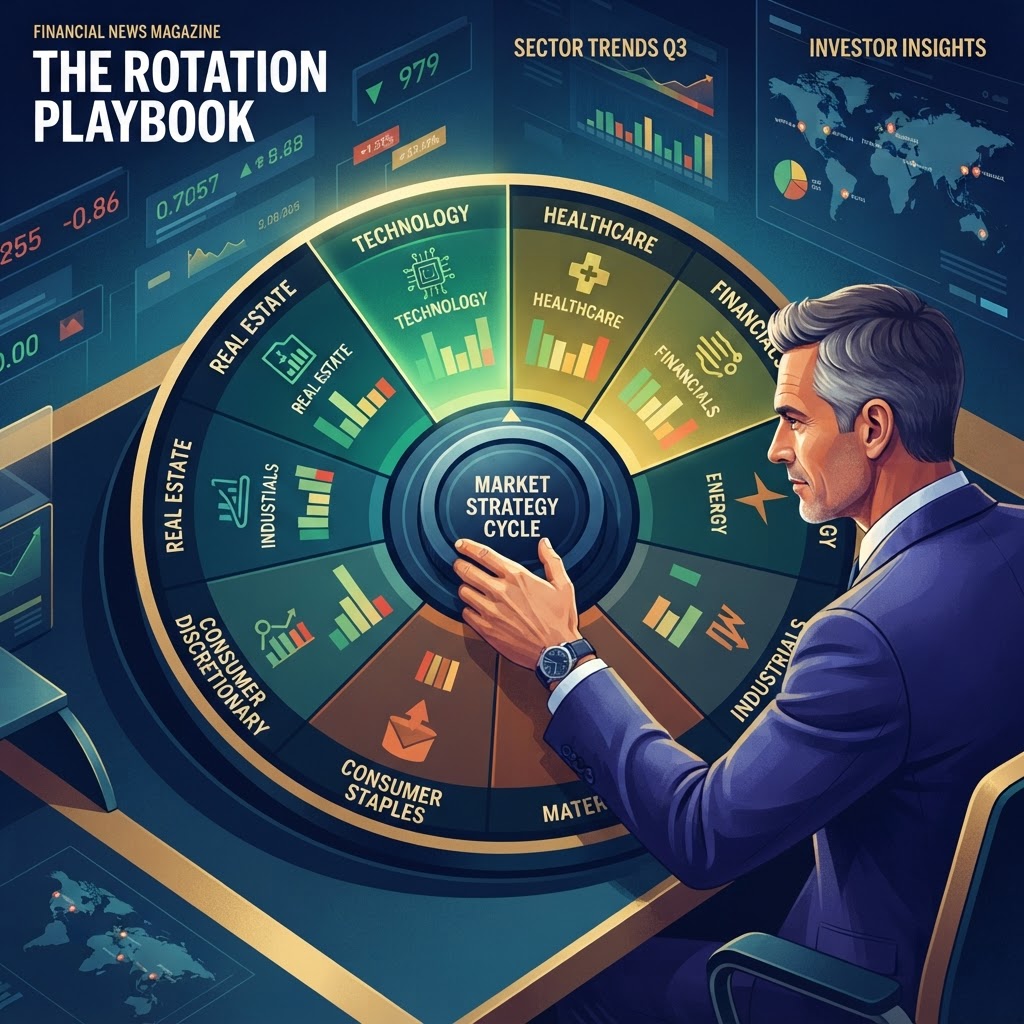
The stock market is never led by the same sectors for long. Leadership rotates, sometimes dramatically and sometimes gradually, as the economic cycle shifts and investors reposition for the next phase. This phenomenon, known as sector rotation, is one of the most powerful and least understood forces in market movement. The same index can produce very different returns depending on which sectors are leading at the time, and the same economic news can be positive or negative for different sectors depending on where we are in the cycle. Understanding sector rotation is essential for any investor who wants to read the market comprehensively, because it explains why the market’s behavior changes across economic phases in ways that a single index number cannot capture.
The Economic Cycle and Sector Leadership
The classic framework for understanding sector rotation is the economic cycle, which moves through four phases — expansion, peak, contraction, and recovery — with different sectors leading in each phase. During expansion, when the economy is growing strongly, cyclical sectors like technology, consumer discretionary, and industrials typically lead, because these sectors benefit from rising consumer and business spending. During the peak, when growth is strong but signs of overheating appear, energy and materials often lead, because inflation and commodity prices are rising. During contraction, when the economy is weakening, defensive sectors like consumer staples, healthcare, and utilities typically lead, because these sectors provide goods and services that people need regardless of economic conditions. During recovery, when the economy is beginning to expand again, financials and industrials often lead, because these sectors benefit from rising interest rates and increasing economic activity.
This framework is not a precise timing tool. The phases do not announce themselves, and the transitions are often visible only in hindsight. But the framework provides a structure for understanding why sector leadership shifts and what the shifts signal about the underlying economy. When cyclical sectors are leading, the market is signaling economic expansion. When defensive sectors are leading, the market is signaling economic caution. When energy and materials are leading, the market is signaling inflationary pressure. Reading these shifts provides a view of the market’s expectations that is more nuanced than any single index number.
How to Measure Sector Rotation
There are several practical ways to measure sector rotation. The most direct is to compare the relative performance of sector ETFs against the S&P 500 over various time horizons. When a sector is outperforming the index, it is in a leadership phase. When it is underperforming, it is in a laggard phase. Tracking these relative performance trends over weeks and months reveals the rotation in progress. The most useful time horizons are one month for short-term shifts, three months for medium-term trends, and one year for longer-term regime changes.
Another useful tool is the relative strength ratio, which divides a sector’s performance by the S&P 500’s performance. A rising relative strength line indicates that a sector is outperforming the market, while a falling line indicates underperformance. These relative strength trends tend to persist for extended periods, because the underlying economic forces that drive them evolve slowly. Identifying sectors with rising relative strength early in a new trend is one of the most reliable ways to position for sector rotation, though it requires discipline to avoid chasing sectors after their relative strength has already extended.
Growth vs. Value: The Great Rotation
One of the most important dimensions of sector rotation is the oscillation between growth and value investing. Growth sectors, particularly technology and communication services, tend to lead during periods of economic expansion and falling interest rates, because their valuations benefit from low discount rates and their earnings benefit from strong demand. Value sectors, particularly financials, energy, and industrials, tend to lead during periods of rising interest rates and inflation, because their businesses benefit from those conditions and their valuations are less sensitive to the discount rate.
The growth-value rotation is one of the most powerful forces in market movement. Periods of growth leadership can last for years, as they did during much of the 2010s, and can produce dramatic outperformance. Periods of value leadership can also last for years, as they did during the 2000s commodities boom, and can produce equally dramatic outperformance. For investors, the key is to recognize which regime is in place and to position accordingly, while understanding that no regime lasts forever and that the transitions can be abrupt.
Defensive vs. Cyclical: The Risk Rotation
A second dimension of sector rotation is the oscillation between defensive and cyclical sectors, which reflects the market’s risk appetite. Defensive sectors — consumer staples, healthcare, utilities — provide goods and services that people need regardless of economic conditions, and they tend to hold up better during market declines. Cyclical sectors — consumer discretionary, industrials, materials — provide goods and services that depend on economic strength, and they tend to outperform during expansions. The relative performance of defensive versus cyclical sectors is a direct read on the market’s risk appetite.
When defensive sectors are outperforming cyclicals, the market is signaling caution. When cyclicals are outperforming defensives, the market is signaling risk appetite. This spread is one of the most reliable indicators of the market’s underlying sentiment, because it is driven by the collective positioning of investors, not by headline news. A market where the index is rising but defensives are outperforming cyclicals is a market that is internally cautious despite the rising headline number. A market where cyclicals are outperforming is a market that is genuinely risk-seeking. Reading this spread provides a view of market internals that is often more informative than the index level itself.
The Concentration Risk of Modern Markets
One of the most important developments in recent market history is the increasing concentration of the major indices in a small number of mega-cap technology companies. When a handful of companies represent a large share of the index, sector rotation within those companies can dominate the index’s movement, while sector rotation among the other 490 companies is obscured. This concentration makes it more important than ever to look beneath the index at the underlying sector leadership, because the index’s headline movement may be driven by a single sector rather than by broad market participation.
Market breadth, which measures how many stocks are participating in a move, is a useful complement to sector rotation analysis. When a sector rotation is accompanied by broad participation, it is more likely to be durable. When a sector rotation is narrow, driven by a small number of large stocks, it is more likely to be fragile. Combining sector rotation analysis with breadth analysis provides a more complete picture of the market’s health than either measure alone.
How to Use Sector Rotation in Practice
For most investors, the practical takeaway is not to try to trade sector rotation actively, which is difficult and requires constant attention. It is to understand the current rotation regime and to position the portfolio appropriately for it, while maintaining enough diversification to weather the inevitable transitions. During periods of clear cyclical leadership, a portfolio tilted toward technology and consumer discretionary may be appropriate. During periods of defensive leadership, a more balanced allocation with exposure to healthcare and consumer staples may be appropriate. The goal is not to rotate perfectly but to be aware of the regime and to avoid being positioned against it.
The most important discipline is to recognize that no sector leads forever. The sectors that led the last bull market are rarely the sectors that lead the next one. The investors who understand this and who maintain diversified exposure across sectors are the ones who benefit from rotation rather than being hurt by it. Sector rotation is one of the most powerful forces in market movement, and reading it well is one of the most valuable skills an investor can develop. The market’s leadership is always shifting, and the investors who recognize the shifts early, and who position their portfolios accordingly, are the ones who compound their wealth through every phase of the cycle.