
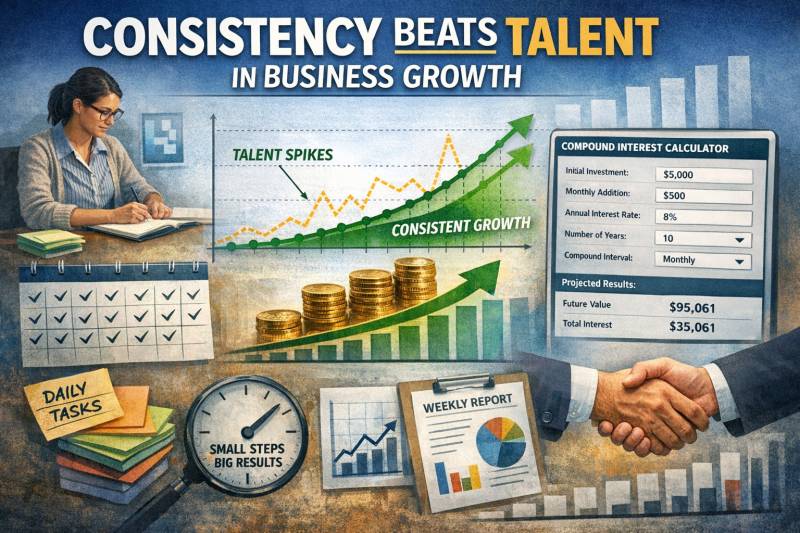

In business, talent often receives most of the attention. Entrepreneurs who are naturally gifted at sales, marketing, leadership, or innovation are frequently seen as having a major advantage. While talent can certainly create opportunities, long-term business growth is far more dependent on consistency.
Consistency is the process of taking repeated, focused action over time. In many cases, businesses that grow steadily are not the ones with the most brilliant ideas or the most charismatic founders. Instead, they are the ones that continue executing daily, weekly, and monthly strategies without interruption.
This disciplined approach creates compounding progress that becomes increasingly difficult for competitors to match.
The Daily Actions That Build Momentum
Business growth rarely happens through one major breakthrough. Instead, it usually develops through hundreds or thousands of small improvements.
Publishing content regularly, following up with leads, improving products, refining customer service, and analyzing performance metrics are all examples of consistent actions. Individually, these efforts may seem minor. Over time, however, they begin to create meaningful advantages.
Companies that show up every day build stronger brand recognition. Customers become familiar with their messaging, trust grows, and engagement increases. This momentum can lead to higher conversion rates and more predictable revenue.
Talent may help a business start fast, but consistency helps it sustain growth.
Compounding Effects in Business Performance
Just as money can compound, business activities can also compound. Marketing campaigns that run consistently tend to generate cumulative visibility. Customer relationships deepen with repeated positive interactions. Operational efficiencies improve as processes are refined.
For example, a business that adds just one percent improvement to its processes each month may experience significant gains over a few years. These incremental gains stack together and eventually transform the organization.
Understanding this compounding effect can shift the focus away from short-term wins toward long-term systems.
Business owners can even use financial modeling tools to visualize how steady growth impacts revenue projections. By experimenting with different growth assumptions using the calculator here:
they can estimate how small monthly increases in revenue or investment returns might influence long-term outcomes.
This type of projection reinforces the importance of maintaining consistent performance.
Reliability Builds Trust
Customers and clients value reliability. When a business consistently delivers quality products, meets deadlines, and communicates clearly, trust develops naturally.
Trust reduces friction in the buying process. Returning customers are more likely to make repeat purchases, recommend the business to others, and provide positive feedback.
Talent alone does not guarantee reliability. Even highly skilled individuals can struggle if they lack structured routines or accountability systems.
Consistency, on the other hand, demonstrates professionalism and dependability.
The Role of Systems and Processes
Consistency becomes easier when businesses develop repeatable systems. Standard operating procedures, automated workflows, and performance tracking tools allow teams to maintain quality even as they scale.
For instance, content marketing strategies often succeed because of structured publishing schedules. Instead of posting sporadically, businesses that release articles, videos, or updates on a regular timetable tend to build larger audiences.
These audiences grow gradually, creating ongoing traffic and engagement that compounds over time.
Systems transform consistency from a personal trait into an organizational capability.
Small Improvements Create Competitive Advantages
Many businesses attempt to outperform competitors through large, dramatic changes. While innovation can be valuable, it is often the accumulation of small improvements that creates lasting competitive advantages.
Improving response times by a few minutes, reducing product defects by a small percentage, or increasing customer satisfaction scores slightly can all contribute to stronger performance.
When these improvements occur consistently, they can result in significant differences in profitability and market positioning.
Organizations that embrace continuous improvement tend to adapt more effectively to changing conditions.
Emotional Discipline in Business Growth
Consistency also requires emotional discipline. Markets fluctuate, customer behavior shifts, and unexpected challenges arise. Business owners who rely solely on motivation may struggle during difficult periods.
Those who rely on structured habits are more likely to continue taking productive action even when results are temporarily slow.
This persistence allows businesses to benefit from long-term compounding effects.
For example, marketing campaigns often require months before delivering meaningful returns. Companies that abandon their strategies too early miss out on potential growth that could have emerged later.
Consistency helps bridge the gap between effort and reward.
Measuring Progress Over Time
Tracking performance metrics is essential for maintaining consistent growth. Key indicators such as revenue trends, customer acquisition costs, website traffic, and conversion rates provide valuable feedback.
When businesses review these metrics regularly, they can identify which actions are producing results and which areas need adjustment.
Over time, data-driven decisions improve efficiency and resource allocation.
Using projection tools can further enhance planning. By modeling scenarios involving steady growth rates, business owners can better understand how consistent performance may influence long-term financial outcomes.
This clarity encourages sustained effort and reduces the temptation to chase short-term gains.
Building a Culture of Consistency
Organizations that prioritize consistency often develop strong internal cultures. Team members understand expectations, workflows become predictable, and collaboration improves.
Clear routines reduce confusion and enable employees to focus on delivering value rather than constantly adapting to new directions.
Leadership plays an important role in reinforcing this culture. When leaders demonstrate steady commitment to goals and processes, teams are more likely to follow.
Over time, this shared discipline becomes part of the company’s identity.
Long-Term Growth Favors Persistence
Business history is filled with examples of companies that achieved success through sustained effort rather than sudden breakthroughs. While talent can spark innovation, it is persistence that turns ideas into scalable operations.
Consistent marketing, consistent product development, and consistent customer engagement all contribute to long-term stability.
Even modest growth rates, when maintained over extended periods, can produce substantial expansion in revenue, market share, and brand influence.
This principle mirrors financial compounding, where small gains accumulate into large outcomes.
Businesses that focus on steady execution often discover that progress accelerates naturally as their foundation strengthens.