
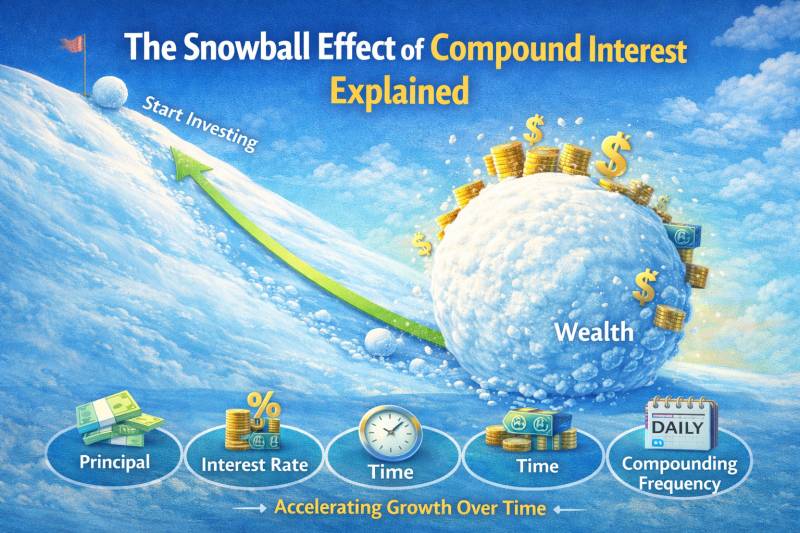
Many people believe that building a large investment portfolio requires a high income, a large inheritance, or the ability to take significant financial risks. In reality, one of the most reliable paths to long-term wealth begins with small, consistent investments. Over time, these modest contributions can grow into substantial portfolios through the combined effects of compounding, patience, and disciplined financial behavior.
Understanding how this process works can help individuals remove the psychological barrier that prevents them from starting. The size of the first investment matters far less than the consistency of ongoing contributions and the time allowed for growth.
The Power of Starting Small
Starting with a small investment offers several advantages. It reduces financial pressure and allows individuals to gain experience without risking large sums of money. This early exposure helps investors understand market fluctuations, asset allocation, and the emotional side of investing.
For example, investing $100 per month may not feel significant in the short term. However, this habit establishes a routine. As months turn into years, the total invested capital begins to increase steadily. More importantly, the investment returns generated along the way begin contributing to portfolio growth.
The key principle is that early action creates momentum. Even limited resources can produce meaningful results when given enough time.
Consistency as a Growth Engine
Consistency is one of the most important drivers of portfolio expansion. Regular investments, whether weekly or monthly, create a steady inflow of capital. This approach is often referred to as dollar-cost averaging.
By investing at regular intervals, individuals reduce the impact of market volatility. Some contributions will be made when prices are high, while others will occur during market declines. Over time, this balances the average purchase price of assets.
As the total investment base increases, even modest market returns begin generating larger dollar gains. A portfolio that grows from $5,000 to $50,000 produces very different outcomes from the same percentage return.
This shift illustrates how consistency transforms small beginnings into meaningful financial progress.
Compounding Accelerates Portfolio Expansion
Compounding plays a central role in turning small investments into large portfolios. When investment earnings are reinvested rather than withdrawn, they become part of the capital base that generates future returns.
In the early stages, compounding effects may appear subtle. Portfolio growth may seem slow because returns are calculated on relatively small balances. However, as the portfolio grows, compounding begins to accelerate performance.
For instance, a 7% annual return on a $10,000 portfolio produces $700 in gains. The same return on a $100,000 portfolio produces $7,000. The percentage remains constant, but the dollar impact increases dramatically.
This acceleration highlights why long-term investors often focus more on time in the market than timing the market.
Increasing Contributions Over Time
Another important factor in portfolio growth is the ability to gradually increase contributions. As income rises due to career advancement, business success, or additional income streams, investors can allocate more funds toward investments.
Even small increases can have significant effects. Raising monthly contributions from $100 to $200 doubles the rate at which capital accumulates. Over decades, this difference can translate into hundreds of thousands of dollars in additional portfolio value.
Lifestyle management plays a role here. Individuals who avoid excessive lifestyle inflation can redirect income growth toward investment opportunities. This behavior strengthens compounding and speeds up wealth accumulation.
The habit of increasing contributions aligns financial progress with personal development.
Diversification and Risk Management
As small portfolios grow, diversification becomes increasingly important. Spreading investments across different asset classes — such as stocks, bonds, real estate, or index funds — can reduce overall risk while maintaining growth potential.
Diversification helps protect portfolios during market downturns. While some assets may decline, others may remain stable or even increase in value. This balance allows investors to remain committed to long-term strategies without reacting emotionally to short-term losses.
Small investors often benefit from diversified funds or exchange-traded funds that provide broad market exposure. These tools make it possible to build balanced portfolios without needing large amounts of capital.
Over time, diversification supports sustainable growth and reduces volatility.
Reinvesting Dividends and Earnings
Dividend reinvestment is another mechanism that helps small investments expand into large portfolios. When dividends are automatically used to purchase additional shares, the investor increases ownership without contributing new funds.
This process creates a cycle of ownership expansion. More shares generate more dividends, which then purchase even more shares. Over decades, this can significantly boost total returns.
The same principle applies to capital gains. Reinvesting profits rather than withdrawing them maintains the compounding process. While taking profits may feel rewarding in the short term, allowing investments to remain active often produces stronger long-term outcomes.
Portfolio growth depends not only on what is invested, but also on what is allowed to remain invested.
The Psychological Advantage of Portfolio Growth
Watching a portfolio grow from small beginnings can create powerful psychological motivation. Early milestones — such as reaching $5,000 or $10,000 — reinforce the value of consistent investing.
As balances increase, investors often become more confident and disciplined. This confidence reduces the likelihood of panic selling during market downturns. It also encourages continued contributions even during uncertain economic conditions.
Financial resilience is built gradually. Small investments help individuals develop emotional tolerance for market fluctuations, which becomes increasingly important as portfolios grow larger.
Confidence, patience, and experience become assets alongside financial capital.
Time as the Ultimate Multiplier
Time is perhaps the most important factor in transforming small investments into substantial portfolios. Investors who begin in their twenties or thirties have decades for compounding to operate. Even those who start later can still benefit from disciplined strategies.
The difference between investing for ten years versus thirty years can be enormous. Longer time horizons allow portfolios to recover from downturns, capture multiple economic cycles, and benefit from sustained growth trends.
While market performance cannot be controlled, the length of time invested can often be managed through early planning and consistent action.
Small investments, when supported by time and discipline, can evolve into financial resources capable of supporting retirement, business ventures, property ownership, or generational wealth planning. 📈