
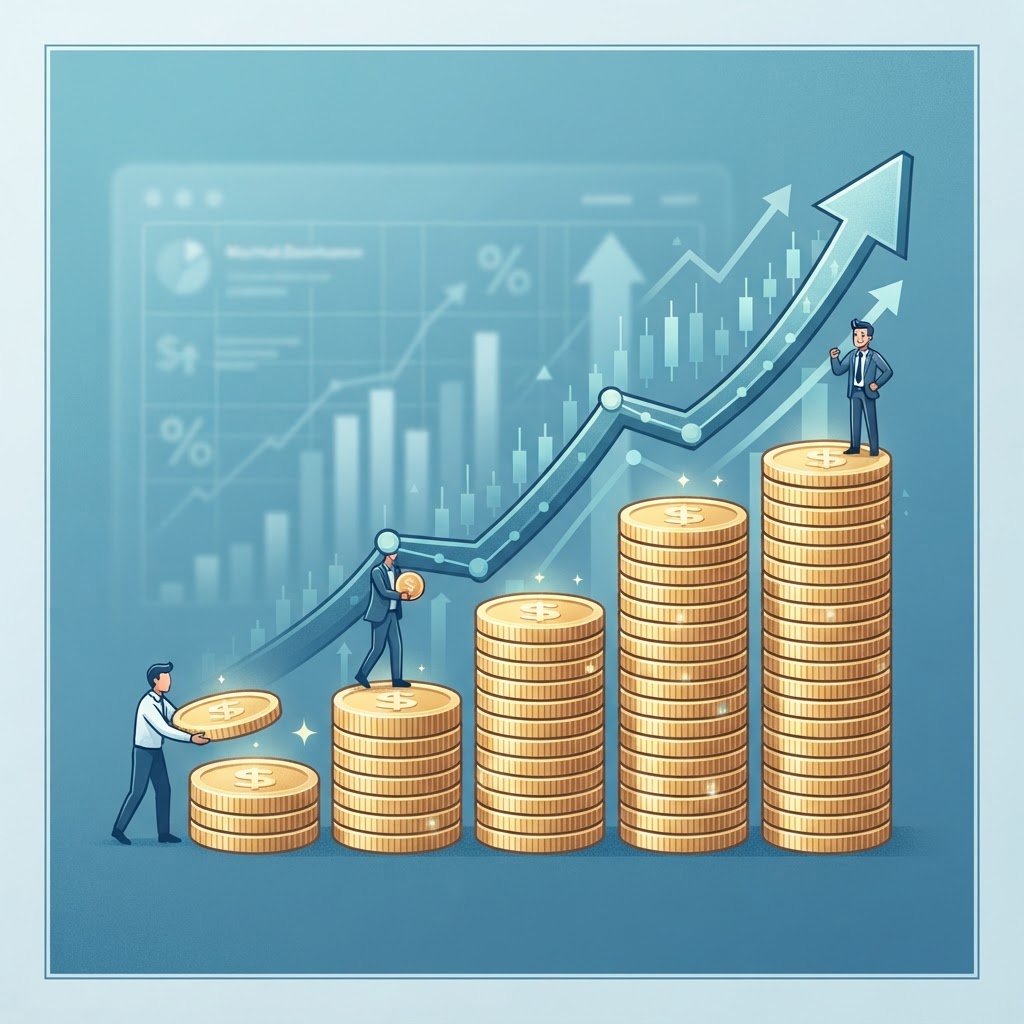
If there is a strategy that consistently outperforms the majority of professional investors while requiring almost no skill, time, or effort, it is the combination of index fund investing and dollar-cost averaging. This strategy is not exciting. It does not produce stories of spectacular gains or brilliant market calls. It is, by any measure, boring. But boring is exactly what young investors should want, because boring strategies are the ones that work over decades, while exciting strategies are the ones that blow up. Understanding why index funds and dollar-cost averaging are so effective, and how to implement them, is the foundation of a sound investment plan for any beginner, and it is the strategy that has built more wealth for more ordinary investors than any other approach in history.
What an Index Fund Is
An index fund is a mutual fund or exchange-traded fund that holds all the securities in a particular market index, in the same proportions as the index. An S&P 500 index fund holds all 500 companies in the S&P 500, weighted by their market capitalization. A total stock market index fund holds virtually every publicly traded company in the United States. An international index fund holds companies from around the world. The defining characteristic of an index fund is that it does not try to beat the market. It tries to be the market, by holding everything and letting the aggregate performance of all companies determine the return.
This approach has a powerful advantage over active management, which tries to select the best stocks and avoid the worst. Study after study has shown that the majority of actively managed funds underperform their benchmark indices over long periods, because stock selection is difficult, fees drag on returns, and the best-performing stocks in any year are often unpredictable. Index funds avoid these problems by holding everything, which ensures they capture the full return of the market, including the stocks that perform best, without the cost and risk of trying to pick winners. The result is a low-cost, diversified investment that reliably captures the long-term growth of the stock market, which is exactly what most investors need.
Why Index Funds Outperform
The outperformance of index funds over active management is one of the most well-documented findings in finance, and it is driven by three factors. The first is cost. Index funds have very low expense ratios, often below 0.10%, because they do not require teams of analysts to research stocks or portfolio managers to make trading decisions. Active funds have much higher costs, often 1% or more, which drag on returns year after year. Over decades, the cost difference compounds, and the lower-cost index fund pulls ahead by a significant margin. A 1% annual fee, over 30 years, can reduce final wealth by roughly 25%, which is a staggering cost for the hope of outperformance that, statistically, does not materialize.
The second factor is diversification. An index fund holds hundreds or thousands of stocks, which eliminates the risk of any single company’s failure significantly impacting the portfolio. An active fund, which holds a smaller number of stocks, is more concentrated and more vulnerable to the poor performance of individual holdings. The third factor is behavioral. Index funds, because they are passive and automatic, remove the temptation to trade based on emotion, which is one of the biggest destroyers of investor returns. The investors who buy and hold index funds through market cycles capture the full return of the market, while the investors who try to time the market or pick stocks often underperform, because they sell at the bottom and buy at the top.
Dollar-Cost Averaging Explained
Dollar-cost averaging is the practice of investing a fixed amount of money at regular intervals, regardless of market conditions. For example, an investor might invest $500 on the first of every month, buying shares whether the market is up, down, or flat. The effect of this approach is that the investor buys more shares when prices are low, because the fixed amount buys more shares at lower prices, and fewer shares when prices are high, because the fixed amount buys fewer shares at higher prices. Over time, this lowers the average cost per share, which improves returns.
Beyond the mechanical benefit of lowering average cost, dollar-cost averaging provides a powerful behavioral benefit, because it removes the need to time the market. One of the most difficult decisions in investing is when to invest, and many investors delay investing because they are waiting for a better price, which means they sit in cash while the market rises. Dollar-cost averaging eliminates this decision, because the investor invests on a schedule regardless of market conditions, which ensures they are always participating in the market’s growth. The investors who dollar-cost average consistently capture the full return of the market, because they are always invested, while the investors who try to time the market often miss the best days, which are concentrated in short periods and which disproportionately affect long-term returns.
The S&P 500 as the Core Holding
For most investors, the S&P 500 index fund is the ideal core holding, because it provides exposure to the 500 largest companies in the United States, which collectively represent the bulk of the US economy and a significant portion of the global economy. The S&P 500 has historically delivered annualized returns of around 10% before inflation, or around 7% after inflation, over long periods. This return, compounded over decades, is the engine that builds wealth for patient investors. An investor who dollar-cost averages into an S&P 500 index fund over 30 or 40 years captures the growth of the American economy, which has been one of the most reliable wealth-building forces in history.
The S&P 500 is also self-cleansing, because companies that decline and lose market capitalization are eventually removed from the index and replaced by growing companies, which means the index always reflects the current leaders of the economy. This automatic rebalancing ensures that an S&P 500 index fund always holds the most successful companies, without the investor needing to make any decisions about which companies to own. The investors who buy and hold an S&P 500 index fund, and who add to it regularly through dollar-cost averaging, build wealth through the growth of the economy, which is the most reliable and accessible source of long-term returns available.
The Role of the Nasdaq and Other Indices
While the S&P 500 is the ideal core holding for most investors, some young investors with long time horizons and higher risk tolerance may allocate a portion of their portfolio to the Nasdaq, which is more concentrated in technology and growth companies. The Nasdaq has historically delivered higher returns than the S&P 500 over long periods, because technology companies have grown faster than the overall economy, but it has also been more volatile, with deeper drawdowns during bear markets. For young investors who can tolerate the volatility, a Nasdaq allocation can boost long-term returns, but it should be balanced with the broader S&P 500 to manage risk.
Beyond domestic indices, international index funds provide exposure to companies outside the United States, which adds diversification and reduces the risk of the portfolio being overly concentrated in a single country. A common approach is to hold a mix of US and international index funds, with the US portion typically larger for investors who believe in the long-term growth of the American economy. The specific allocation matters less than the discipline of investing regularly and holding for the long term, because the power of compounding over decades overwhelms the differences between reasonable allocation choices. The investors who focus on consistency and patience, rather than on optimizing their allocation, are the ones who build the most wealth.
Implementing the Boring Path
Implementing the index fund and dollar-cost averaging strategy is remarkably simple. The investor opens a brokerage account, selects a low-cost index fund, and sets up automatic contributions on a regular schedule. The contributions are invested automatically, regardless of market conditions, and the portfolio is held for the long term without trading or adjustment. This simplicity is the strategy’s greatest strength, because it removes the decisions that lead most investors astray. There is no stock to research, no market to time, no manager to evaluate. There is only the discipline of regular investment and the patience to let compounding work.
The most important thing for beginners to understand is that the boring path is not a compromise or a second-best option. It is the strategy that has built the most wealth for the most investors over the longest period, and it is the strategy recommended by the most respected investors and financial researchers. The investors who embrace the boring path, who invest regularly in low-cost index funds, and who have the patience to let compounding work over decades, build wealth that exceeds what the majority of active investors achieve. The boring path is the reliable path, and for the young investors who follow it, the rewards are substantial, dependable, and worth far more than the excitement of any speculative strategy that promises quick gains but delivers disappointment. The boring path is the path to wealth, and it is available to every investor who has the discipline to follow it.