
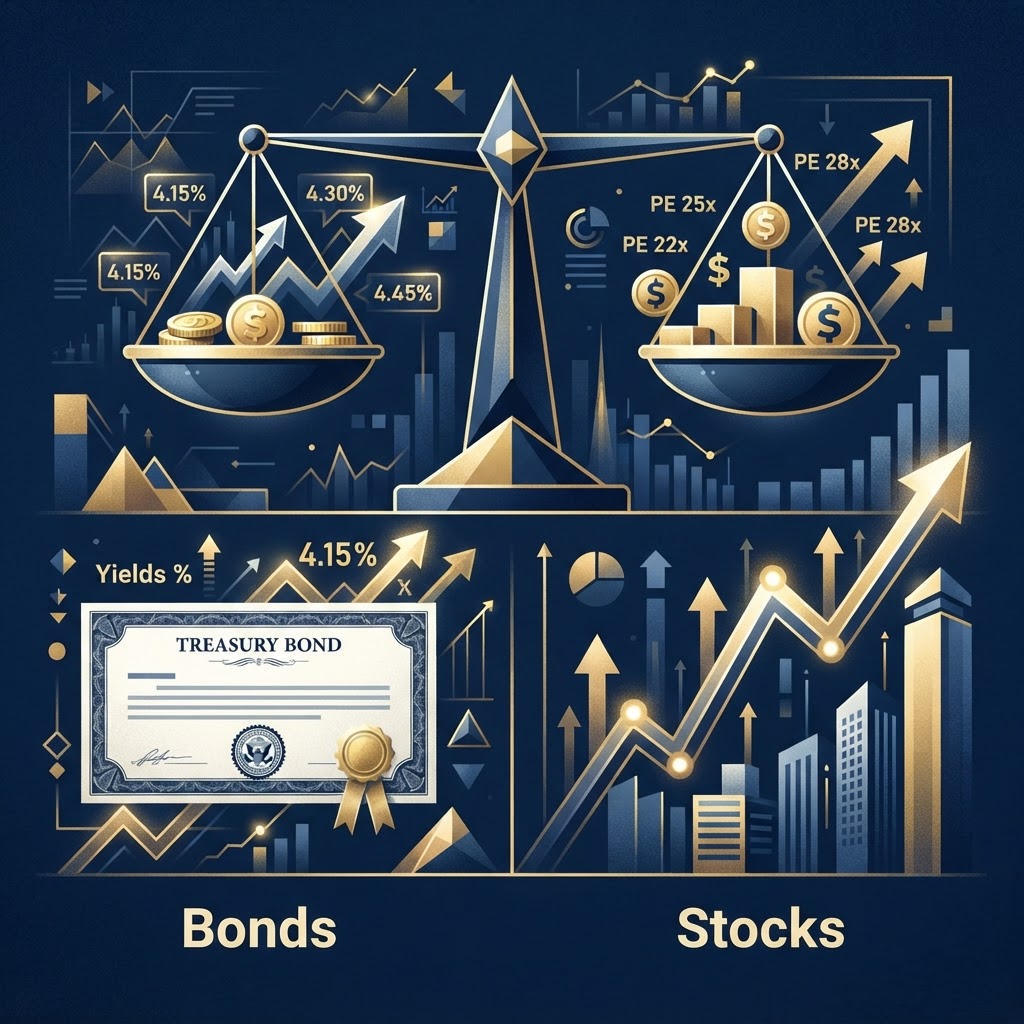
One of the most important relationships in all of finance is the one between bond yields and stock valuations, and it has become increasingly central as investors navigate an environment where interest rates are no longer pinned at historic lows. For more than a decade, near-zero interest rates distorted the relationship between bonds and stocks, making stocks almost always preferable to bonds and inflating the valuations of long-duration growth assets. As rates have normalized, the relationship has reasserted itself, and the competition between fixed income and equities has become one of the most important forces driving market movements. Understanding how bond yields affect stock valuations, why the effect varies across sectors and styles, and how the rotation between the asset classes works is essential for any investor who wants to read the market through the lens of the most fundamental relationship in finance.
The Discount Rate Channel
The most direct channel through which bond yields affect stock valuations is the discount rate. Every financial asset is valued as the present value of its future cash flows, discounted back to today at an appropriate rate. The risk-free rate, typically represented by the yield on government bonds, is the foundation of that discount rate, because it is the return an investor can earn without taking any risk. When the risk-free rate rises, the discount rate for all assets rises, and the present value of future cash flows falls. This is why rising bond yields put downward pressure on stock valuations, because the same stream of future earnings is worth less when discounted at a higher rate.
The effect is not uniform across all stocks. The stocks most sensitive to the discount rate are those whose cash flows are concentrated far in the future — growth stocks, particularly technology companies whose earnings are expected to grow for years and decades. These stocks have long duration, similar to long-term bonds, and their valuations are heavily dependent on the discount rate. A rise in bond yields can cause a significant decline in the valuation of long-duration growth stocks, even if their underlying businesses are performing well. The stocks least sensitive to the discount rate are those whose cash flows are concentrated in the near term — mature value stocks with stable, current earnings — because their valuations depend less on distant future cash flows and more on current profitability.
The Equity Risk Premium
Beyond the direct discount rate effect, bond yields affect stocks through the equity risk premium, which is the additional return investors demand for holding stocks rather than risk-free bonds. When bond yields are low, the equity risk premium is high, because stocks offer a large premium over the low risk-free rate, which makes stocks attractive relative to bonds. When bond yields rise, the equity risk premium compresses, because the gap between the return on stocks and the return on bonds narrows. If bond yields rise enough, bonds become genuinely competitive with stocks, and capital can rotate from equities to fixed income, pressuring stock valuations.
The equity risk premium is not a fixed number. It fluctuates based on investor sentiment, economic conditions, and the relative attractiveness of stocks and bonds. During periods of economic optimism, the equity risk premium tends to be low, because investors are willing to accept a smaller premium for holding stocks. During periods of economic uncertainty, the equity risk premium tends to be high, because investors demand more compensation for equity risk. Monitoring the equity risk premium, which can be estimated by comparing the earnings yield of the stock market to the bond yield, provides a read on the relative attractiveness of stocks versus bonds, which is one of the most important inputs for asset allocation decisions.
The Growth-Value Rotation
One of the most visible effects of changing bond yields is the rotation between growth and value stocks. When bond yields are falling, growth stocks tend to outperform value stocks, because falling rates boost the valuations of long-duration growth assets. When bond yields are rising, value stocks tend to outperform growth stocks, because rising rates compress the valuations of long-duration growth assets while having less effect on short-duration value assets. This growth-value rotation is one of the most powerful style rotations in the market, and it is driven primarily by the direction of bond yields.
The rotation is not perfectly clean, because other factors affect growth and value stocks, including earnings growth rates, sector dynamics, and investor sentiment. But the bond yield is the dominant structural driver, and the investors who understand the relationship can position their portfolios for the prevailing rate environment. During periods of falling rates, a tilt toward growth stocks is historically rewarded. During periods of rising rates, a tilt toward value stocks is historically rewarded. The rotation between the two styles, driven by the bond market, is one of the most reliable patterns in equity investing, and it is one of the most accessible ways for investors to align their portfolios with the macroeconomic environment.
The Earnings Yield Versus Bond Yield
One of the most useful frameworks for comparing stocks and bonds is the earnings yield, which is the inverse of the price-to-earnings ratio. The earnings yield measures the earnings an investor receives per dollar invested in the stock market, and it can be directly compared to the bond yield to assess relative value. When the earnings yield of the stock market is significantly higher than the bond yield, stocks are attractive relative to bonds, because stocks offer more earnings per dollar than bonds offer in interest. When the earnings yield falls to or below the bond yield, stocks become less attractive, because bonds offer competitive returns with less risk.
This comparison is not perfect, because stock earnings grow over time while bond payments are fixed, which means stocks should trade at a lower yield than bonds to compensate for their growth. But the spread between the earnings yield and the bond yield, adjusted for expected growth, provides a useful read on the relative attractiveness of the two asset classes. When the spread is wide, stocks are historically attractive. When the spread is narrow or negative, stocks are historically expensive relative to bonds, and forward returns for stocks have tended to be lower. The investors who monitor this spread have a disciplined framework for asset allocation that is grounded in valuation rather than sentiment.
The Sector Effects of Changing Yields
Changing bond yields affect different sectors differently, which provides additional information for sector rotation. The most rate-sensitive sectors are those with long-duration cash flows — technology, communication services, and other growth sectors — whose valuations are most affected by the discount rate. The least rate-sensitive sectors are those with short-duration, stable cash flows — consumer staples, utilities, and healthcare — whose valuations are less dependent on the discount rate. Financials are a special case, because they benefit from rising rates, as their net interest margins typically widen when rates rise, which is why financials often lead during periods of rising bond yields.
The sector rotation driven by bond yields is one of the most reliable patterns in equity market movement. Rising yields favor financials and value sectors, while pressuring technology and growth sectors. Falling yields favor technology and growth sectors, while pressuring financials. The investors who understand these sector effects can position their portfolios for the rate environment, tilting toward the sectors that benefit from the prevailing direction of bond yields. This does not require predicting the exact direction of yields, but it does require recognizing the regime and positioning accordingly, which is one of the most effective ways to add value through sector allocation.
Reading the Bond-Stock Relationship for Investment Decisions
For investors reading the market, the bond yield is one of the most important variables to monitor, because it drives the valuation of every asset class and it signals the relative attractiveness of stocks versus bonds. A rising yield environment pressures growth stock valuations, favors value and financial sectors, and makes bonds more competitive with equities, which can lead to rotations between the asset classes. A falling yield environment supports growth stock valuations, favors technology and long-duration sectors, and makes equities more attractive relative to bonds, which supports equity flows.
The practical approach is not to trade the bond-stock relationship actively, which is volatile and difficult, but to use it as context for portfolio construction and for understanding market movements. When the stock market declines during a period of rising yields, the cause is often valuation compression driven by the discount rate, not deterioration in the underlying businesses, which has different implications for long-term investors. When the stock market rallies during a period of falling yields, the cause is often valuation expansion, not improvement in the underlying businesses, which has different implications for forward returns. Reading the bond-stock relationship accurately helps investors distinguish between valuation-driven and fundamentals-driven market movements, which is one of the most valuable analytical skills in investing. The great rotation between fixed income and equities is one of the most powerful forces in the market, and the investors who understand it are the ones who navigate changing rate environments most effectively.