

How Dollar-Cost Averaging Supercharges Compound Interest Growth
When personal financial planners talk to clients about preparing for retirement, two strategies almost always come up: compound interest and dollar-cost averaging. These two concepts work hand-in-hand to build wealth over time, especially for those who want a disciplined, low-stress approach to investing.
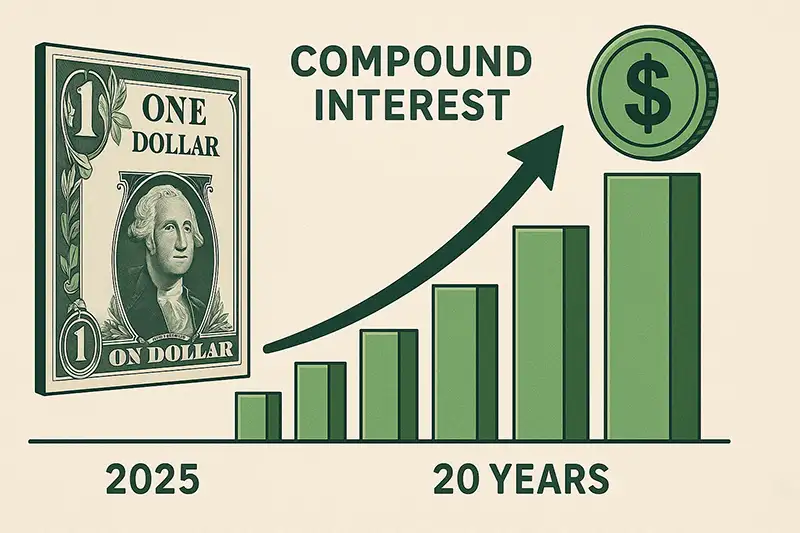
Most people are familiar with the basics of compound interest—earning interest not just on your initial deposit but also on the interest your money has already generated. Over time, this creates an exponential growth effect. The longer you let your money sit and compound, the more dramatic the results.
Dollar-cost averaging (DCA) complements this perfectly. Instead of investing one large sum all at once, you invest a fixed amount of money on a regular schedule—whether that’s weekly, monthly, or quarterly—into a chosen financial vehicle. This could be a savings account, index fund, retirement account, or other investment.
By combining the steady discipline of DCA with the growth power of compounding, you can create a reliable wealth-building strategy that’s less vulnerable to market volatility and emotional investing mistakes.
How Dollar-Cost Averaging Works with Compound Interest
Many descriptions of compound interest indirectly reference dollar-cost averaging without actually naming it. For example, when a financial planner encourages you to make consistent contributions to your 401(k) or IRA, that’s dollar-cost averaging in action.
Here’s a simplified example:
- Scenario 1 – One-time investment: You open a $200 high-yield savings account with Citibank in December 2022, earning 0.70% interest compounded monthly. After five years, without adding more money, you’ll have about $207.12.
- Scenario 2 – Dollar-cost averaging: You start with the same $200 deposit but also contribute $200 every month. After five years, your account would grow to roughly $12,416—a staggering difference, even with a modest interest rate.
The takeaway? The combination of regular contributions and compounding creates a snowball effect. The earlier you start, the larger that snowball can grow.
Beyond Savings Accounts: Expanding the Strategy
Compound interest and dollar-cost averaging aren’t limited to savings accounts, certificates of deposit (CDs), or bonds. Many successful investors—Warren Buffett included—apply these principles to the stock market.
While stocks themselves don’t pay “interest,” some provide dividends, which can be reinvested to purchase additional shares. Over time, reinvested dividends combined with steady contributions can dramatically grow a portfolio.
For example:
- If you invest $500 per month into a dividend-paying index fund and reinvest all dividends, your holdings grow not just from your contributions and market gains, but also from the additional shares purchased with dividends.
- This compounding of both capital gains and dividends accelerates your wealth-building potential.
Why DCA Beats Market Timing for Most Investors
Dollar-cost averaging takes much of the stress out of investing because you’re not trying to “time the market.” Instead, you’re buying assets consistently, whether prices are high or low. Over the long run, this evens out your cost per share and reduces the risk of investing a large amount right before a market downturn.
Yes, it takes discipline—especially during market declines when emotions tempt you to stop investing. But those down periods are actually when your fixed contributions buy more shares for the same amount of money, setting you up for greater gains when markets recover.
Automating Your Path to Wealth
Most banks and brokerages make DCA easy to implement. You can set up automatic transfers from your checking account to:
- A high-yield savings account
- A money market account
- A brokerage account for ETFs or index funds
- A retirement account like a 401(k) or IRA
This automation removes the guesswork and willpower factor, keeping your investments on track even when life gets busy.
The Reality Check: Risks to Keep in Mind
While dollar-cost averaging is powerful, it’s not a guarantee of profits—especially with volatile investments like stocks or crypto. If the market declines for a prolonged period, your portfolio value can drop even with regular contributions. In those situations, it’s important to periodically review your portfolio and make adjustments if necessary.
Dollar-cost averaging and compound interest are like the “dynamic duo” of personal finance—one provides steady fuel, the other multiplies the results over time. Whether you’re saving for retirement, a major purchase, or simply building an emergency fund, these two strategies can help you grow wealth steadily and reduce emotional decision-making.
The key is to start as early as possible, contribute consistently, and let time do the heavy lifting. Your future self will thank you.